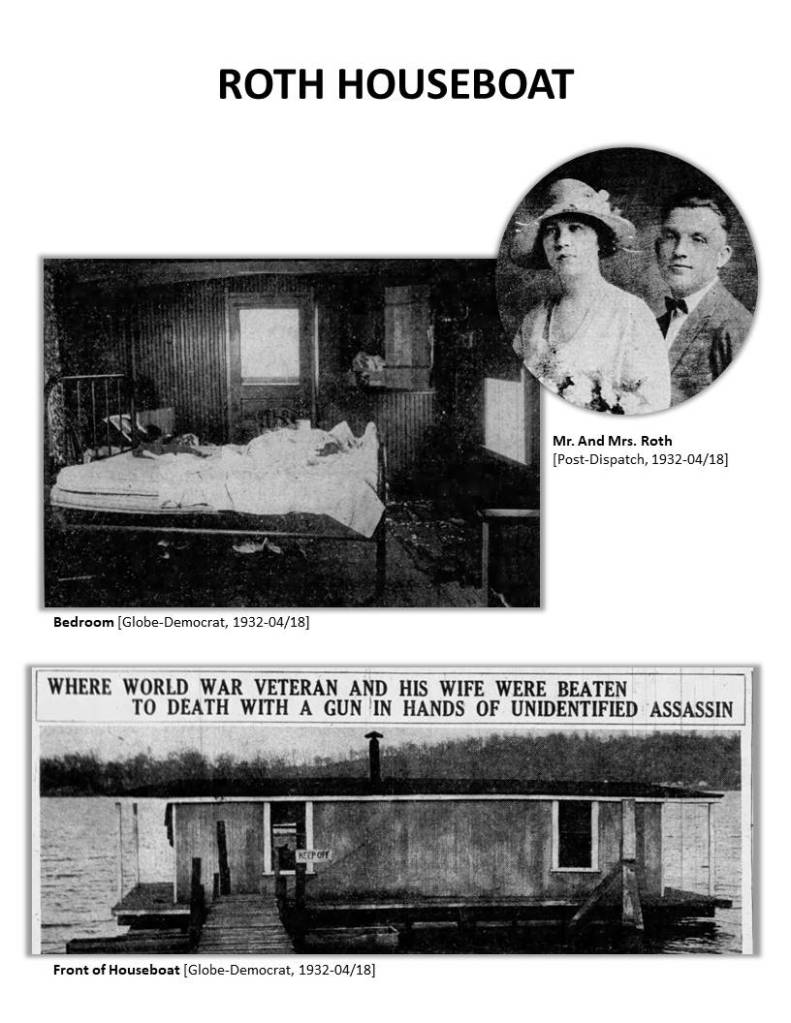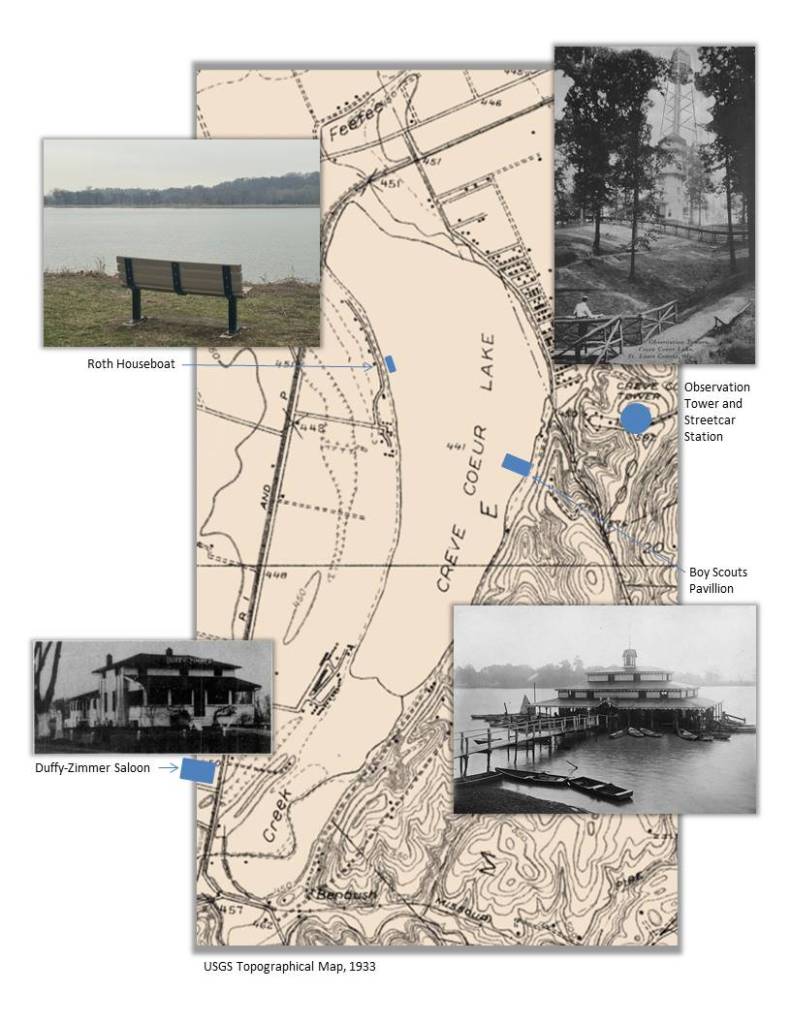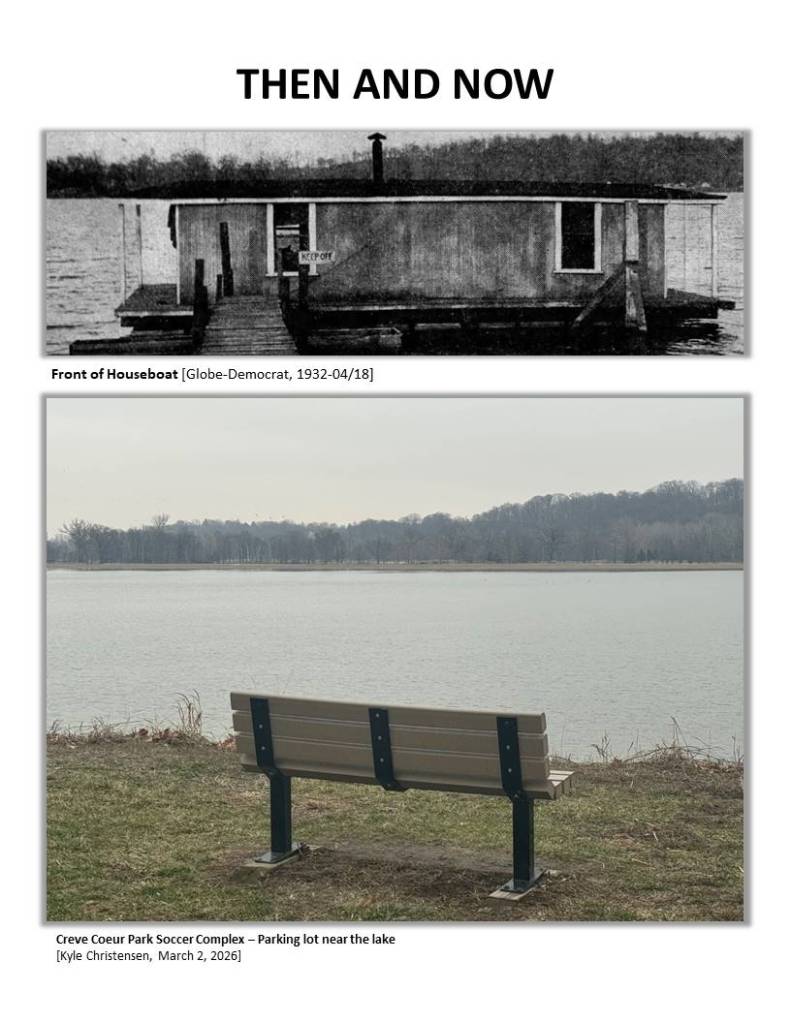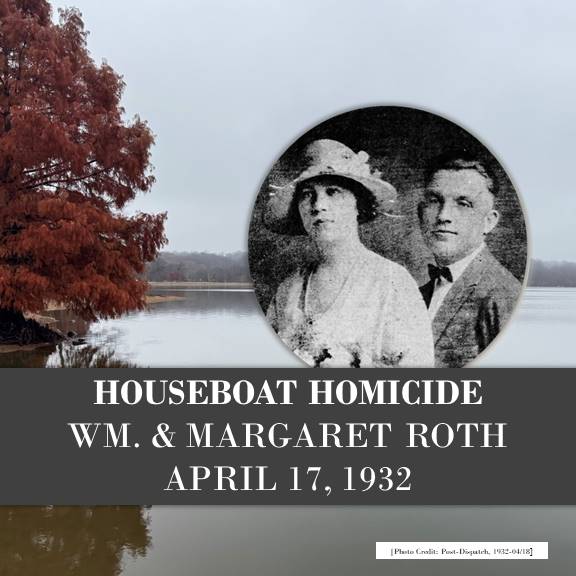
On a cool Spring night in 1932, William and Margaret Roth were awakened by someone knocking on the door of their houseboat on Creve Coeur Lake. It was still early in the season; most people had not yet returned to their summer cottages and cabins. It was too dark to see who was at the door, but not unusual for a lost fisherman or bar patron to come asking for directions. After all, the Roth property was directly across the lake from the 1904 observation tower, a landmark which many visitors used to find their way back to the electric street car depot on the wooded hillside. Despite a large “KEEP OFF” sign posted on the gangway, people would still come up to the door sometimes for directions to get back across the lake.
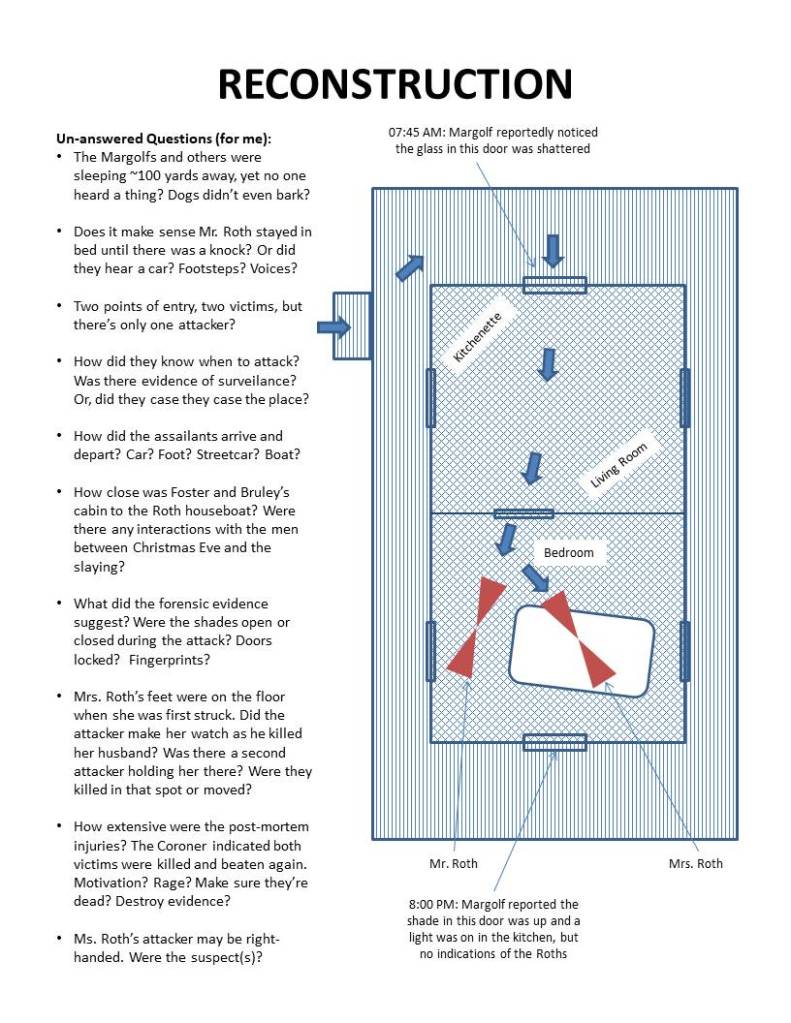
William told his wife to stay in bed and called out for the visitor to, “hang on,” as he slipped on a pair of trousers over his union suit undergarments and started toward the door. Within a few steps, however, someone burst into the tiny boat cabin and struck the husband with the butt-end of a shotgun, knocking him to the ground. The enraged attacker then continued to beat Mr. Roth with the unloaded weapon until the wooden stock split in half and fell to the floor. For good measure, he then smashed a wooden chair over Roth’s body, scattering bits of timber around the small room. Satisfied the husband was now dead, the blood-soaked assailant then picked up the gun barrel from the floor and turned his attention to the terrified wife seated upon the brass bed. Mrs. Roth attempted to shield herself from the first blow, but her arms were no match for the force of the metal club. The coroner estimated that both bodies were beaten far beyond what was necessary to kill them. This wasn’t a “heat of the moment” crime; it was a brutal execution.
The following morning, neighbor Henry Margolf noticed the glass front door of the houseboat was cracked, so he walked over to look closer. As he crossed the gangway, an open window shade in the kitchen revealed the ghastly crime scene inside. Investigators estimated the Roths were murdered some time between 8:00 PM and 1:00 AM, though none of the neighbors heard or saw anything unusual that night. A hatchet and assorted hand tools that Mr. Roth had been using in the yard just hours before the attack sat un-touched next to the single-burner cooking stove. It wasn’t clear if the shotgun was something the assailant brought with him, or picked up at the scene. Investigators never could locate the missing barrel to determine a make and model; they suspected it was likely tossed into the muddy lake as he retreated back into the inky darkness of the Missouri Bottoms.
Newspaper coverage of the vicious slayings immediately put St. Louis on edge. What kind of a monster shows up to murder two people with an unloaded gun (or his bare hands)? Did we have a predator – a Villisca Axe Murderer-type – using the street car lines to find victims? Indeed, investigators found a jacket and hat near the scene that looked as though they’d been rinsed of blood in the cold water; a possible disguise and/or a removable layer of clothing to catch blood splatter.
The Bopp Chapel at Hanley and Forsyth in Clayton was reportedly packed for the double funeral of the slain husband and wife a few days later.
Duffy-Zimmer
However, the County Sheriff had a pretty strong lead from day one. It turned out Mr. Roth, 41, had been involved in an altercation at the Duffy-Zimmer Saloon on Creve Coeur Mill Road, just a few months prior, on Christmas Eve, 1931. It was a well-known hangout for St. Louis gangsters and hoodlums, and whatever transpired that night had sent him to the hospital for sixteen stitches upon his scalp.
William Roth was regarded to be a bit pugnacious; quick to argue or throw hands, especially when drinking. He was a veteran of the Great War who spent most of the 1920s working as a plasterer in St. Louis. When the couple fell on hard times in 1926, they separated, and his much younger bride moved back into her parents’ house in University City. Unable to keep a stable job, Mr. Roth moved into the 16’x25’ houseboat on Creve Coeur Lake so he could catch fish and work odd-jobs to make ends meet. At the time of the murders, Margaret, age 30, was still living with her parents during the week, only visiting her husband on the weekends. It looked to investigators like she may have just been in the wrong place at the wrong time. They felt it was much more plausible that someone with an axe to grind had probably spotted Mr. Roth outside working in the yard that day and returned under cover of darkness to settle the score.
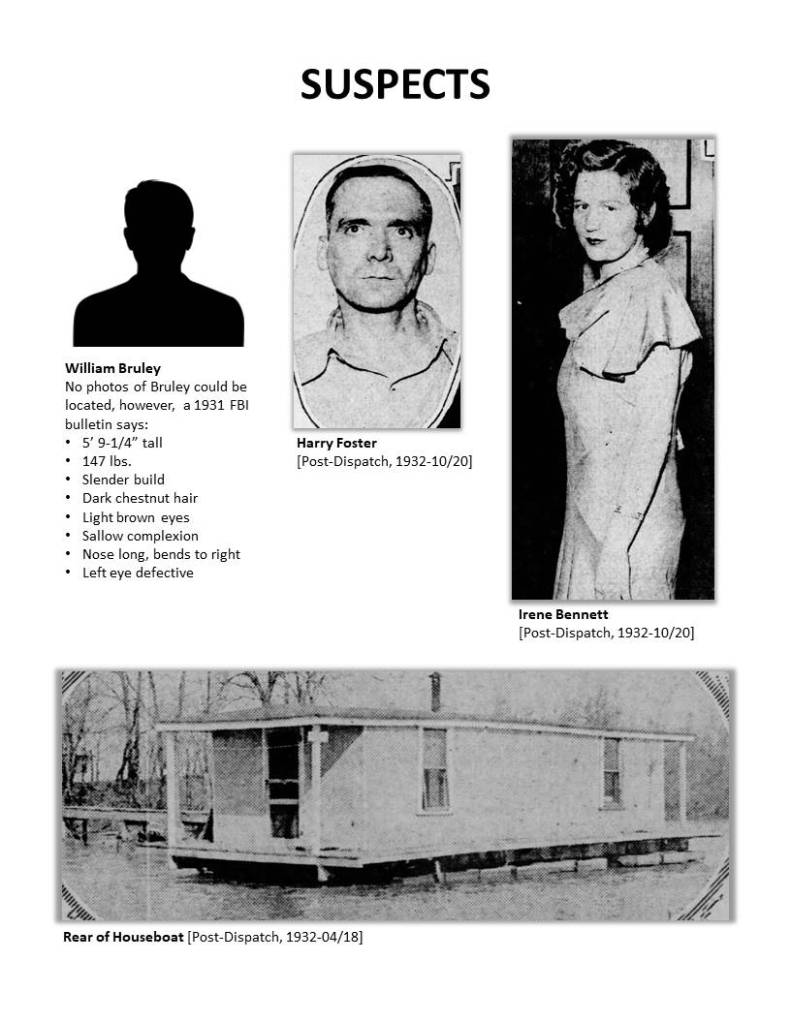
The Sheriff’s Office moved quickly to locate the two men involved in the Christmas altercation: Harry Foster and William Bruley. Bruley was an ex-con from St. Louis who served 3 years in the Missouri State Penitentiary for manslaughter stemming from a bar fight in St. Louis in 1928. Deputies drove out to the Duffy-Zimmer Resort and found Henry Foster still living in the same rented cabin he had been on Christmas Eve. Unfortunately. Bruley was long gone and did not give his pal any indication where he was going. After questioning Mr. Foster for several hours, they decided to wait for Bruley to resurface again.
Six months later, in October 1932, U. City Police execute a traffic stop on a suspected stolen vehicle from Chicago. The female driver, Ms. Mary Irene Bennett, explained that she took the stolen vehicle to get away from her abusive boyfriend, William Bruley, presently hiding out in Chicago. She said that he confessed to murdering the Roths in a moment of candor and was now on the hunt to kill her. She provided authorities with the alias “C.F. Bradshaw” and the address 673 Roscoe Street in Chicago. St. Louis County finally had what they needed to charge Bruley and Foster with murder. FBI agents in Chicago moved in quickly to get Bruley under arrest for the interstate vehicle theft.
Window of Opportunity
For whatever reason, a judge declined to extradite William Bruley to St. Louis County to stand trial for murder, moving forward instead with the armed robbery case in which he had stolen the automobile that Bennett was driving. He was swiftly convicted in Cook County and remanded to the Illinois State Penitentiary in Joliet for a term of six years. Charges against suspected accomplice Henry Foster had to be dropped before investigators were able to get anything useful out of him.
And before the County could even say the word ‘extradition’ again, star witness Irene Bennett gets kidnapped from her home near Skinker and Olive. Two unidentified white men take her to a secluded spot about three miles south of Jefferson Barracks, where she is beaten and abandoned. Ms. Bennett ends up walking to the home of a County Deputy, who drives her to the old County Hospital in Clayton for treatment. Upon her discharge from the hospital for non-life threatening injuries, she disappears without a trace.
When Bruley is released from prison on June 1, 1939, St. Louis County is forced to also drop the homicide charge against him. Their only witness is gone, they never found the murder weapon, and the 7-year-old investigation yielded no other evidence linking him to the crime. William Bruley returned home to St. Louis, where he died in 1955. He was 58 years old.
As of 2026, the brutal murders of William and Margaret Roth remain as yet unsolved. Certain element do align with a revenge killing, but not exclusively. Unfortunately there was never an evidenciary hearing conducted so it is difficult to say how much the County did or did not have against Bruley, Foster, and Bennett… or any alternative theories investigators may have explored.
The couple is interred at the Valhalla Cemetery on Natural Bridge Road.
(C) Kyle Christensen, March 3, 2026. All Rights Reserved.