
As St. Louis County prepares to prosecute Elmer Dowling, victim Louis Lee Baker struggles to cope with PTSD, celebrity, and a mountain of broken promises. The city’s hero is about to get caught up in a major political upheaval that will forever tarnish his legacy, relegating his memory to the trash bin instead of textbooks.
Termination
On the day Lee and Odessia leave for their honeymoon, administrators at Homer G. Phillips move to terminate his employment, citing job abandonment. Baker had racked up three months of bills for treatment, plus another three months of free room and board in a modest, staff apartment that was the perk of a 24/7 on-call maintenance man position. Unfortunately, Baker wasn’t at a point in his recovery yet to take on such a demanding role, nor was there much clarity around his obligations as patient vs. employee vs. local hero at the hospital.
Mayor Dickmann had put them in an impossible spot with Baker. The man was a hero for ALL St. Louisans, yet he was now the sole responsibility of the “colored hospital” in perpetuity? So many problems could have been avoided if the mayor had asked the hospital first, or bothered to ask the hero where he wanted to work.
Thus, just six months after being shot twice in the head and losing an eye, Baker found himself in front of the Civil Service Commission to challenge his dismissal from the city for unsatisfactory performance. In the end, Dickmann managed to pivot Baker into a temporary position as a porter in the barber shop at the old City Workhouse (prison) until a permanent role could open up in another department. It was a major blow to his self-esteem, and it rubbed the Lion’s Club crowd and Mayor’s office the wrong way to have to rescue him so soon after celebrating him.
Dowling on Trial
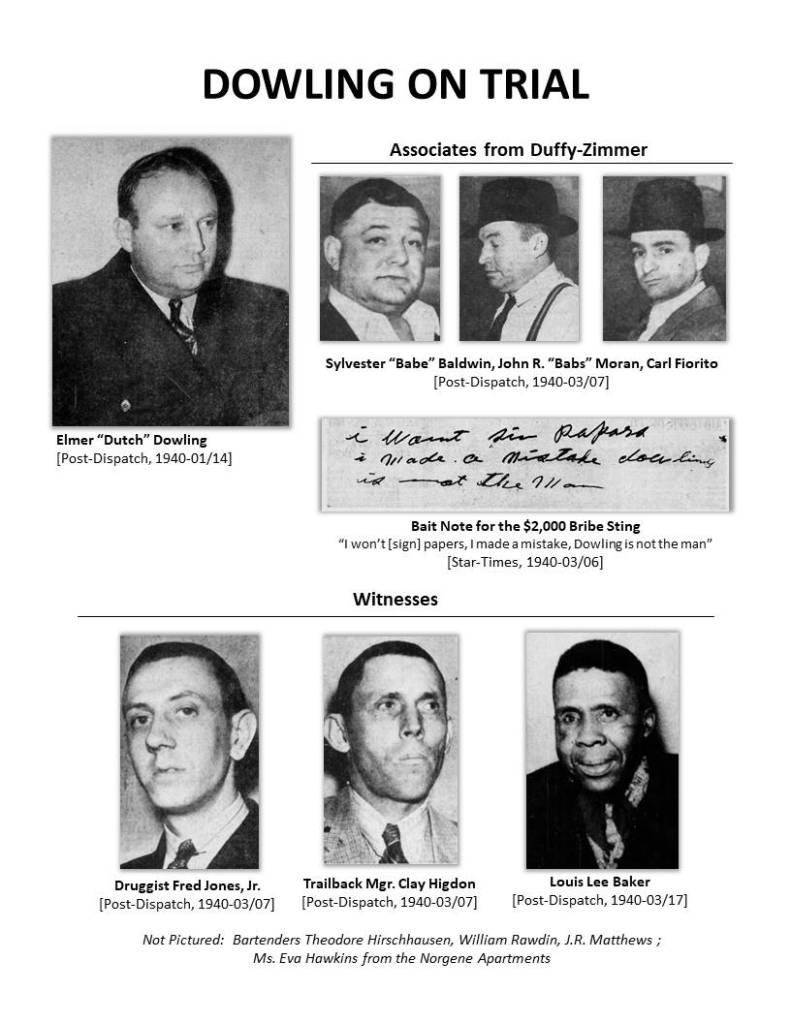
The trial of Elmer Dowling in St. Louis County Circuit Court was short and sweet, lasting a total of only five days. The Prosecutor had seven witnesses lined up and well-prepared for trial. They brought in three bartenders from the Duffy-Zimmer and two, solid witnesses from their stops in Farmington. All were able to corroborate Baker’s timeline and identification of Dowling as the “Big Man.”
The only surprise witness was Ms. Eva Hawkins, landlady at the Norgene Apartments, near the Gaslamp District. She testified that on the morning of Baker’s attack, Dowling rented an apartment – a hideout – and moved in a few personal belongings that he hastily left behind. Dry Cleaning receipts had his name plus Baldwin and Londe. A steamer trunk contained 0.38-cal shells consistent with those used on Baker. It was a bit of a “mic drop” moment that tied it all together.
On the opposing side, the entire defense pivoted on S.O.D.D.I. (some other dude did it). While Dowling was on the run, a stranger contacted Baker and offered him $2,000 to recant his identification of Elmer Dowling. SLMPD advised the witness to play along and setup a meeting for a takedown, but it never materialized. The defense submitted a handwritten note from Baker into evidence that made it look like he really wanted to take the bribe, but the un-signed document was actually just bait. The curveball reportedly threw the witness off his game for a second, but after a short recess he came back and finished strong.
It took the jury just four hours to return a unanimous verdict of guilty. Elmer Dowling was sentenced to 30 years in prison for assault with intent to kill.
PTSD
Increasingly feeling powerless and out of control, Lee begins taking his frustration out on Odessia behind closed doors. Financial stress, low self-esteem, the sudden passing of a loved one (his mother), and social isolation are the all-too-familiar cocktail for domestic violence.
Three months after the Dowling trial ends, an argument breaks out between Lee and Odessia in their home after an evening of drinking. Upstairs in their bedroom, words turn to violence as he knocks her to the ground and begins kicking her. Baker’s guard, James Wintersmith, hears Odessia screaming in terror from his vehicle outside and rushes toward the commotion. Upstairs he finds Lee enraged, towering over his wife, who is severely beaten on the floor. He has no choice but to place his protectee under arrest, and call for assistance to transport Odessia to Homer G. Phillips. The following day, newspapers declare Baker a wife beater, finding it quite amusing that the “negro porter” of the City Workhouse was about to become an inmate for the next 30 days. Lee declares to reporters that he’s ready for a divorce and grateful for the time apart.
Odessia is badly injured in the attack and genuinely afraid of her second husband. Turns out, it’s not the first time he’s been violent in their short marriage. She moves forward to grant him the divorce he says that he wants. Sadly, as so often is the case, family and friends urge her to reconsider after filing. Putting a good man in jail won’t help anything, they say. Church folks stop by to encourage her to give the Lord more time to heal her pain before turning to the legal system. The faithful Odessia, upon release from the hospital with a black eye and stitches, appeals Judge Nangle to downgrade it to a $90 fine for disturbing the peace. The embarrassed couple promises not to drink so much in the future and laughs the incident off publicly, but a sullen husband resents being rescued by his wife.
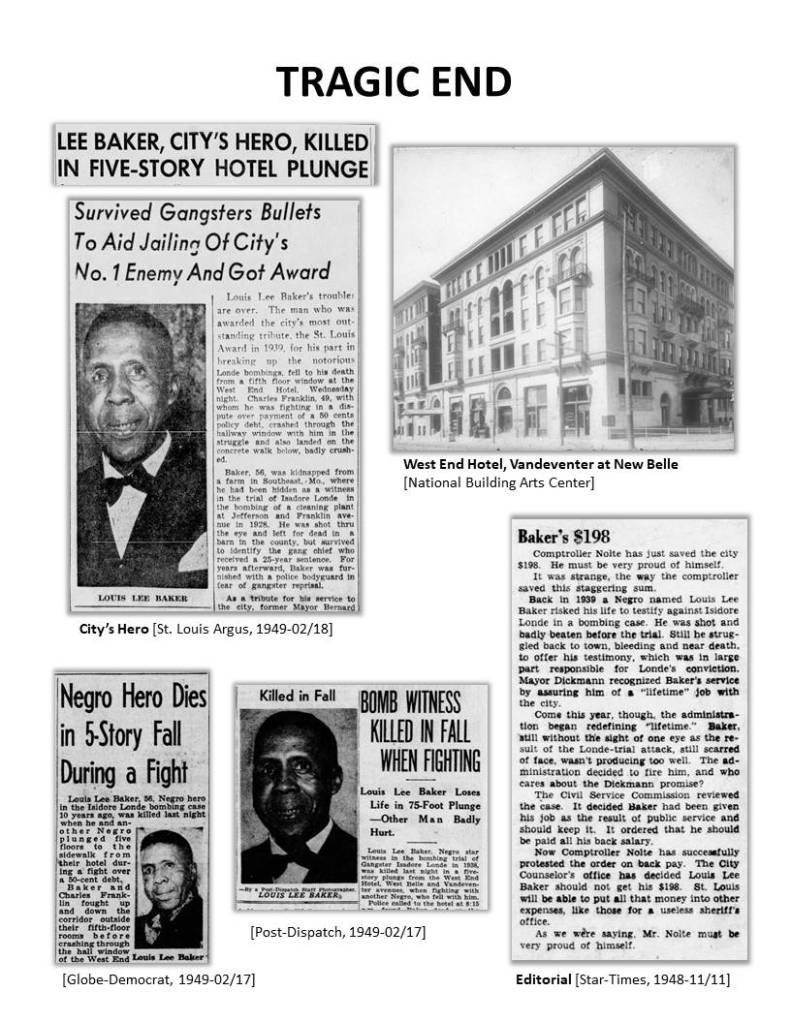
Three months more, in October 1940, Lee attacks Odessia again, this time in the front yard. A crowd of neighbors gather to watch as he throws rocks at his injured wife on the ground and says he’s going to kill her. A different guard assigned to protect Baker, Clarence Stanford, once again has to place him under arrest. He again goes in front of Judge Nangle, who doubles the fine to $180 for disturbing the peace. At the end of her rope, Odessia is forced to put him out of the house, but agrees to stay married and faithful to him. Lee moves into a studio apartment at the West End Hotel, at the corner of Vandeventer and West Belle, near Turner Park.
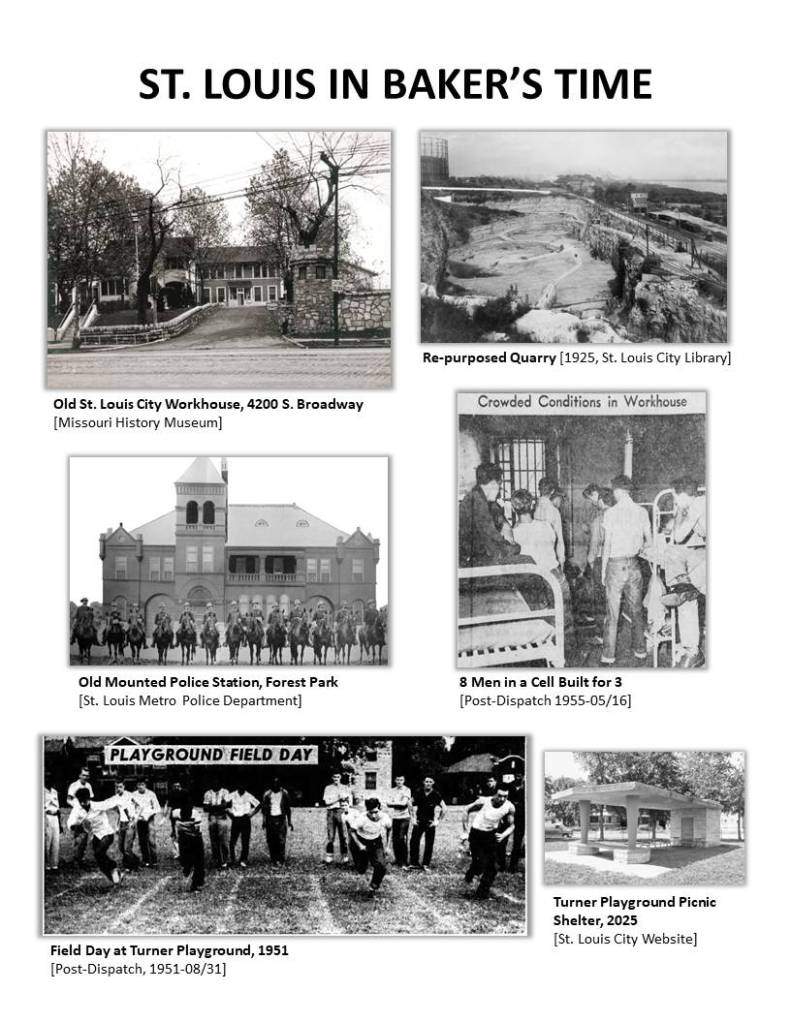
For Christmas 1940, Mayor Dickmann finally comes through with a better position in the Parks Department. Lee becomes a watchman at the old Mounted Police Station in Forest Park… but it requires a pay cut. At $63/month, it brings him more in-line with the average take home pay of a black man.
Political Shift
As the Great Depression dragged on and U.S.-involvement in the War in Europe appeared to be inevitable, a surprise wave of Conservatism swept through St. Louis City government. In April of 1941, Republican William Becker defeated the popular and well-connected Bernard Dickmann, ushering in an eight-year period of extreme cost-cutting and efficiency measures intended to put people back to work in the private sector by scaling back the City’s government. The new mayor’s “efficiency drives” faced little scrutiny or push-back from the Republican-controlled Board of Aldermen – or transparency with local media.
In all fairness, the Missouri GOP had a pretty good track record during the Gilded Age. Rolla Wells and David Francis fought hard to attract the 1904 World’s Fair, forcing through a massive overhaul of city infrastructure to make it happen. Henry Kiel built the Muny and widened the streets downtown. They were the kind of men who could make deals and form public-private partnerships to get things done. William Becker was not. His philosophy was more along the lines of, ‘let’s stop cutting the grass and see if private enterprise steps forward with a better deal.’
Unfortunately, it was the Great Depression and there were no partnerships to be had. As a city built on industry, business leaders were relying on federal funding from the New Deal and Works Progress Administration– immoral socialism in the eyes of some – to keep their steel foundries and hardware factories open.
And for the average, blue-collar St. Louisan, they didn’t understand the new scarcity was just political posturing. All they could see was overcrowded schools, not enough nurses at city hospitals, potholes going un-filled, and trash not collected. All it did was reinforce unfounded fears that our city was being over-run by Southern Blacks moving north in the Great Migration. It wouldn’t be long before disgraced local celebrity Lee Baker would find himself in the cross-hairs of the bitter racial and political divide.
In late August of 1941, Mayor Becker appointed Palmer Baumes to be the new Parks Commissioner. On day one, his first order of business was to roll into Forest Park and dismiss 200 employees without notice, including Baker. For context, Forest Park and all of its attractions (zoo, museums, grounds) employs about 3,300 people today, and it was likely a much larger number 85 years ago when St. Louis City had over 816,000 residents. As a percentage of the workforce, it was only maybe a 2-3% reduction on paper, but terminating so many grass-cutters, trash collectors, and cleaners added unnecessary hardship for a lot of low-income families. When it hit the papers that Baker had been fired from his lifetime job, Baumes relented and brought him back, stating it must have been a clerical error.
Two weeks later, Odessia visits her husband at the West End Hotel to inform him she is giving up the house on Spruce to move in with her oldest son in the Ville. Baker again becomes enraged, attacks his wife, and had to be arrested by one of his guards. This time he gets Judge George Grellner and Odessia appears in court to say she is “absolutely” done with him now. Grellner gives Lee the option of a $200 fine that he cannot pay, or a 30-day stay in the City Workhouse.
The Workhouse, by the way, is not the medium security facility on the Northside that was forced to shut down in 2021. In Baker’s time, the City Workhouse was a Civil War-era prison camp built out of an old quarry where South Broadway hugs the limestone bluffs of the Mississippi River. It was a severely over-crowded and dangerous place frequently subject to rioting, violence, and illness.
And, just as city hero Lee Baker is settling into his new cell, the State Crime Lab in Jefferson City finally gets around to analyzing the bullets that doctors pulled out of his body after the attack. They conclude that both bullets were fired from the same gun, casting serious doubts upon the the star witness’ credibility. Never mind that his attackers crept up on him in a dark room and shot him from behind. On September 25, 1941, the Missouri State Supreme Court remanded Elmer Dowling to the St. Louis County Courts for retrial.
County Prosecutors stalled for eight months trying to pull together a new case against Dowling, knowing that victim Louis Lee Baker’s public reputation would be scorched earth for any St. Louis County juror. Unfortunately, they would be unable to come up with much of anything that wasn’t already in the previous trial. As the jury heads out of the courtroom to deliberate, Judge Witthaus reportedly offers a foreshadowing warning: “if you find this defendant guilty out of malice, not merit, criminal penalties could range from $100 to 5 years in prison.” On May 21, 1942, Elmer Dowling was acquitted and walked out of the Courthouse in Clayton a free man after serving just 16 months of his 30-year sentence.
Two weeks later, Chief Glassco announced the police department would be withdrawing Baker’s police guard detail. Since no further legal action against Dowling is planned, he could no longer be considered a witness. And, with Isadore Londe firmly behind bars, the threat upon his life is all but neutralized. Reading between the lines, your author also suspects the SLMPD was probably running out of black officers to guard him after almost three years of 24/7 protection.
Lee is angry about the sudden turn of events, but decides to re-build a peaceful, quiet life away from the spotlight. He is granted a transfer from Forest Park to the Turner Playground at Sarah and New Belle, near his home.
Mill Creek Rallies Around Lee Baker
Invigorated by another sweeping Republican victory in a heavily Democratic city in ‘45, Mayor Kaufman and his administration set out to finally oust Louis Lee Baker from the City’s payroll once and for all.
Kaufmann brings back “efficiency drives,” despite the Great Depression and WWII rationing being over. First, they roll out a resident survey and dock Lee $5/month for littering complaints at Turner Playground. It is never explained how litter could be used to adjust the pay of a watchman. The following winter, another efficiency measure turns off the heat to the building (read: picnic shelter) to which he is assigned. Supervisors reprimand him multiple times for leaving his post to warm up in the businesses surrounding the park, regardless that he is always in full-view of the playground and ball fields that no one is using. Despite all of the shenanigans, Lee holds on and eventually gets his pay back up to $125/month.
On October 20, 1947, the City of St. Louis again moves to terminate Baker. He subsequently falls five weeks behind on rent, putting him on the cusp of becoming un-housed if he cannot secure something fast. St. Louis’ black newspaper, the Argus, implores its readers to rally around the city’s forgotten hero. The paper runs an interview with the manager of the West End Hotel who declares Baker to be an excellent tenant who always pays the rent on time. Reporters then resolve to reach out to local elected officials and put them on the hot seat to restore him. As a measure of last resort, they connect with former Mayor Dickmann, now serving as Postmaster for St. Louis. He begrudgingly agrees to give Baker a temporary position as a night watchman at the Post Office, but insists that the city must be held accountable to find him a permanent position.
Five days shy of twelve months later, on October 15,1948, Lee Baker finally gets his watchman job back at Turner Playground by decree of the Civil Service Commission. As a final sleight against Baker, City Comptroller Louis Nolte refuses to approve $198 in backpay as ordered by the Commission. He calls it a matter of “routine,” not spite. The only way the CSC can order back pay according to the charter, he explains, is if the employee is fired for religious, racial, or political reasons. Terminations for being disabled don’t get back pay. Even St. Louis’ conservative newspaper, the Star-Times, rebuked Nolte for being so petty.
Return to Vicksburg
After finally being restored to his lifetime position with the city, Lee Baker once again settles into a modest life of quiet obscurity at the West End Hotel. He is not a wealthy man, but he reportedly finds joy living among his long-time friends and a community that loves him. Always cantankerous, he likes to be the “policy man” for penny lotteries and dice games between the old men in the building.
On February 17, 1949, a night no different than any other, Lee gets into a tussle with long-time pal Charles E. Franklin over a lottery bet. Franklin insists he bet $0.50, Baker says it was only $0.25. As the old men playfully bicker over a quarter in a fifth-floor hallway, Lee loses his balance and falls through a window, somehow taking his friend along with him. Baker is killed in the five-story fall and Franklin appears to survive somehow, but is permanently disabled.
Faithful to the end, his widow Odessia resolves to fulfill her second husband’s desire to return home to Vicksburg, Mississippi. St. Louis’ Black community and the W.S. Wade Funeral Home come together to help her get it done.
St. Louis’ hero Louis Lee Baker was laid to rest beside his mother in the Beulah Cemetery in Vicksburg. Standing beside Odessia at the service were his son, Floyd, three stepsons, and a brother, Will Brown. He was only 56 years old.
At the time of Baker’s death, the Mayor and Comptroller were on the way out. After years of bitterly dividing the party, the Missouri GOP passed over Kaufmann for another term, and Nolte did not win re-election. As two lame ducks in their final days in office, it is not clear if the city ever extended condolences to the family or paid the $198.
Legacy
Although Louis Lee Baker absolutely deserves to be celebrated for securing convictions against two of St. Louis’ most vicious gangsters, his 10-year fight with the city must also be commended. He did not ask for a lifetime appointment, it was his modest reward for outstanding public service. He could have said, “to hell with it,” at any point, but he chose to stay and fight. Time after time, he appeared before the Civil Service Commission in his own defense with no one else beside him but God. His strong values and outgoing nature helped people see past his disabilities, skin color, scars, and headlines.
His public battle with City Hall through the 1940’s helped build public awareness and support for at least two major improvements in the decades after his death:
- In 1977, the ‘Office on the Disabled’ was created to help make St. Louis City accessible for everyone. Residents and employees can visit room 30 at City Hall for assistance with understanding accommodations, requesting them, and programs/resources that can help with expediting appeals.
- In 1986, Forest Park became a regional asset. A non-profit conservancy called Forest Park Forever partners with the city to restore, maintain, and sustain the park in perpetuity. It is too important to the regional economy to be the sole responsibility of the City Parks Department.
Much more than just a witness or a victim in the story arc of gangsters, Lee Baker was a good man who never backed down from injustice of any kind.
(C) Kyle Christensen, February 25, 2026, All Rights Reserved.
 TalesfromtheLou.com