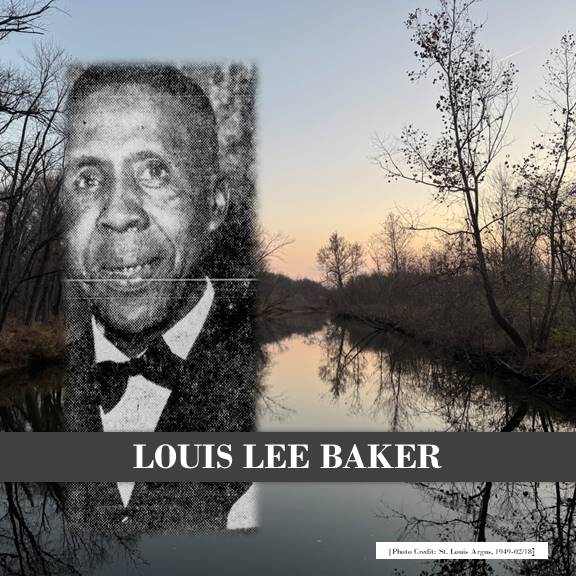
With Isadore Londe firmly on his way back to prison for many years, authorities were once again under tremendous pressure to locate Baker’s assailants.
Investigators in St. Louis County quickly zeroed in on three persons of interest from the Duffy-Zimmer that night: Sylvester “Babe” Baldwin, John “Babs” Moran, and Carl Fiorito. All three men had long criminal histories and a suspected connection to just about every illegal racket – and racketeer – in St. Louis.
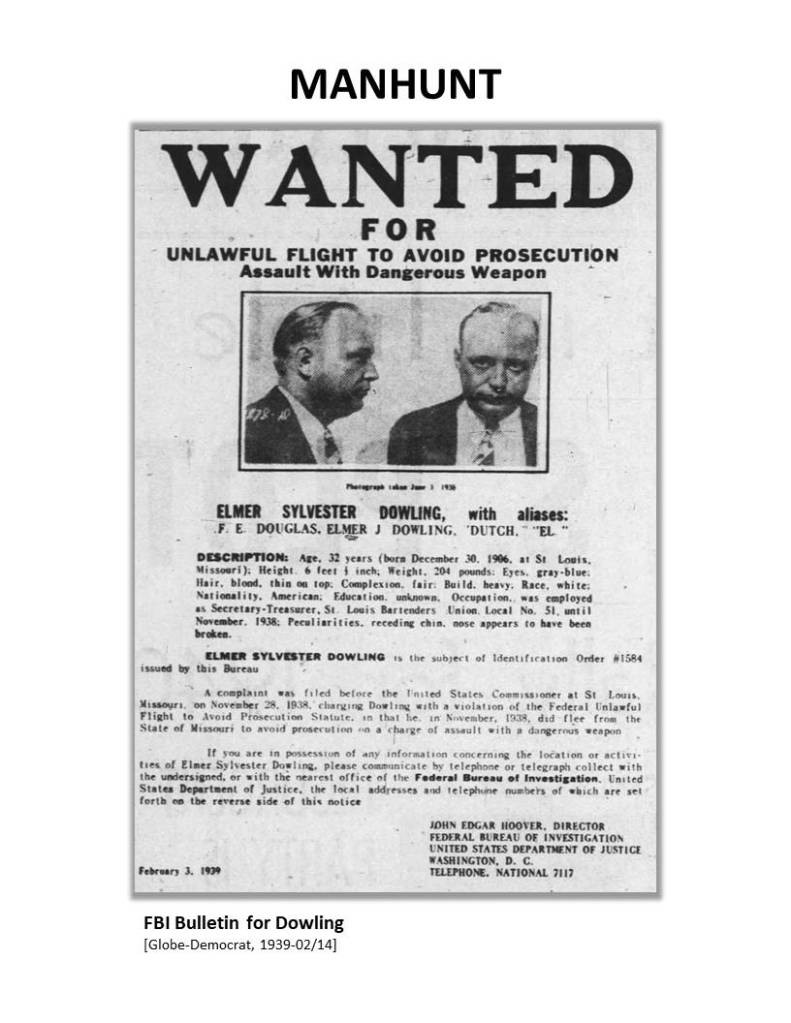
FBI Manhunt
Following the repeal of Prohibition in 1933, many local gangsters moved into shaking down labor unions. They would find a striking union, insert themselves into negotiations by providing strong-arm services against the employer (usually extortion, violence or sabotage). Afterwards, they would then exert control over the union’s leadership, operating and pension funds, put friends on the payroll, purchase cars and run-up travel and entertainment expenses to carefully extract every penny. Baldwin himself lived off-and-on for years in the hotel and cabins on the Duffy-Zimmer Resort at the expense of local union members.
As investigators leaned into this theory, a motive and a suspect began to emerge. Isadore Londe appeared to be the hired muscle and collector in Baldwin’s union shakedown schemes. They alleged that he threw the bomb at Howard’s to coerce the owners into agreement with the striking cleaners’ union. It would be plausible, then, that Baldwin, Moran, and Fiorito might be willing to arrange a murder to avoid the details of their racket being exposed publicly. And, as agents looked back at the photo of the dismissed juror, questions began to swirl regarding their associate Elmer Dowling, now conspicuously missing from St. Louis. Baldwin had recently assumed control of the local Bartenders’ Union and installed Dowling to its management. The day of the Baker kidnapping, he hastily resigned his position and supposedly skipped town over missing money. Word on the street was he was now encased in concrete at the bottom of the Mississippi River for embezzling from his criminal pals. Was it all just a distraction to throw investigators off the trail of a would-be assassin? Indeed, several witnesses at Duffy-Zimmer, and Baker himself, identified a photo of Dowling as the “Big Man” who drove the car that night.
With a positive identification in hand, the St. Louis County Prosecutor moved to convene a grand jury in Clayton, returning two indictments. Formal charges were brought against Elmer “Dutch” Dowling, and a “John Doe indictment” was issued for his as-yet unidentified accomplice. John Doe indictments are frequently used to stop the statute of limitations for violent crimes, allowing investigators time to flip through thousands of potential suspects with the victim.
On top of state charges, the FBI was also activated by federal charges for fleeing across state lines. The statute carries minimal penalties if convicted, but working with the Feds would prove invaluable to the investigation. Immediately they set about distributing thousands of wanted posters for Dowling.
The Accomplice
The FBI started by piecing together Dowling’s movements before and after the attack. That morning, Dowling and another man had met with the Motion Picture Machinists’ Union in St. Louis before heading south toward Sikeston. Those in attendance recalled the partner’s name to be James or Jimmy Monroe. Authorities in Kansas City were all-too-familiar with this alias.
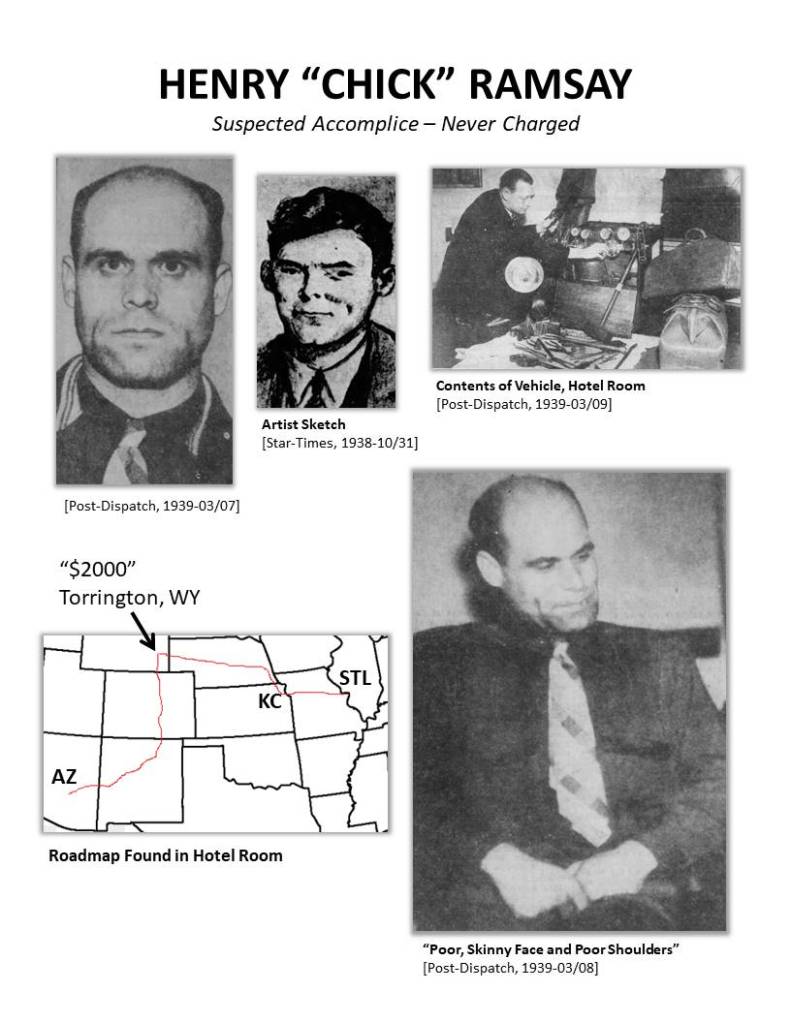
Henry “Chick” Ramsay was a failed golf pro-turned-hustler and ex-con who grew up on the Kansas side of Kansas City. In 1931, he was sentenced to four years in the State Penitentiary for an armed robbery in St. Joseph. Following his release in 1935, law enforcement had been chasing him all over the region for a variety of scams, schemes, and crimes. Too dumb to be a good criminal, and too impulsive to ever go straight, there was always a waiting list for police departments to question him whenever he’d get picked up by law enforcement.
In the Spring of 1939, FBI agents discovered Ramsay’s car tucked away in an auto repair shop in Kansas City under a false name. Inside they found assorted safe-cracking tools, an acetylene torch, locksmithing supplies – basically a mobile crime workshop. When Ramsay returned to pick up his vehicle, KCPD tailed him to a nearby hotel and picked him up on suspicion of robbery. Inside his hotel room, they found quite a bit of evidence suggesting that he was hastily preparing to head West. A roadmap with an odd route from St. Louis to Arizona, passing through Kansas City, Nebraska, Wyoming, Colorado, and New Mexico. Above the town of Torrington, WY, the first exit along the Lincoln Highway in Wyoming, was the note “$2,000,” possibly indicating a planned Western Union payment to help with the journey. Authorities also found an electric sunlamp for tanning and a canvas deposit bag from the Chippewa Trust Company in St. Louis. An account number written on the bag linked it to the Casa Loma Ballroom, which had been robbed of $775 in December of 1937. This evidence allowed SLMPD to charge Ramsay with robbery and bring him over to St. Louis for questioning. Investigators also showed his photo to Baker, who strongly believed it could be one of his assailants.
If ever there was a man with “a poor, skinny face, and poor shoulders,” it was Henry Ramsay. Now back in St. Louis, sitting across from investigators at police headquarters, he melts into a chair as detectives un-packed the mountain of evidence against him. When questioning pivoted from the Casa Loma to attempted murder, Ramsay failed miserably to distance himself from the crime by placing himself at the scene, around the time it occurred, but without being involved. He admitted to accompanying Dowling to the Machinists’ Union a few hours before the kidnapping, but said they parted ways afterward. Ramsay claimed he spent the afternoon at a bar near the Delmar Loop, before departing with a buddy and a couple of ladies after supper. They drove two vehicles out to a secluded corner of Creve Coeur Lake for a romantic, drunken encounter with the women, apparently undeterred by the moonless night and freezing temperatures. When his companions started back toward the city, Ramsay recalled that he may have popped into the Duffy-Zimmer around 9:00 PM to warm up and play cards. Probably not, but if someone insists they saw him, that’s why he might have been there.
Unfortunately, no matter how strongly investigators liked Henry Ramsay for the attempted murder of Baker, they had strict instructions from the County Prosecutor. If Louis Lee Baker has any hesitation whatsoever, cut the suspect loose. They knew all too well that if a black victim accused the wrong white man, the entire case could fall apart. Clayton had several upstanding, white witnesses lined up to testify against Dowling to vouch for Baker’s recollection, if and when law enforcement could locate him. The second attacker never got out of the car at any of the stops, and no one besides Baker could identify him with certainty. It would inevitably devolve into a he said, she said situation that a one-eyed black man was all but assured to lose. In other words, don’t let Baker f— this up!
When the victim arrived at police headquarters, it was clear that he was under the same instructions. Standing there in the office of John Carroll, SLMPD Chief of Detectives, Baker spent over five minutes carefully examining Ramsay. The biggest problem was the lack of hair; Baker was adamant his attacker had a full head of black hair carefully parted to one side. Investigators noticed this, too, and KCPD chimed in that he had been bald for years. It was possible he wore a wig during the attack, but they never recovered one, nor did police think he was intelligent enough to concoct a disguise. After all, he held onto the deposit bag from a robbery he committed two years earlier. And now trying to view the suspect standing there in the detectives’ office, the proportions felt wrong, too. Ramsay was roughly the same height and weight as Dowling, at least according to the stats printed on the FBI wanted posters. Without being able to view Ramsay shoulder-to-shoulder with Dowling as they had been on the night of the attack, the witness had his doubts. As much as Baker wanted authorities to keep looking into Ramsay for the attack, he had to admit that he couldn’t provide the certainty required to get him charged and held.
After police cut him loose, Henry Ramsay high-tailed it out of Missouri. He goes off the radar for the next decade, re-emerging one last time in Richmond, Virginia, in 1949. His name appears briefly in the Kansas City Star in connection to a large jewelry heist in Richmond; just enough exposure to be found by anyone who might be looking for him. He is never seen or heard from again after 1949.
California Dreamin’
Toward the end of 1939, a second suspect emerged as police dug deeper into Isadore Londe’s activities while out on bond in the months leading up to the trial. It turned out he had, in fact, been in Southern California as he claimed. He had crossed paths with law enforcement several times in and around Los Angeles, and frequently with the same accomplice: Alfred “Leo” Selvaggi.
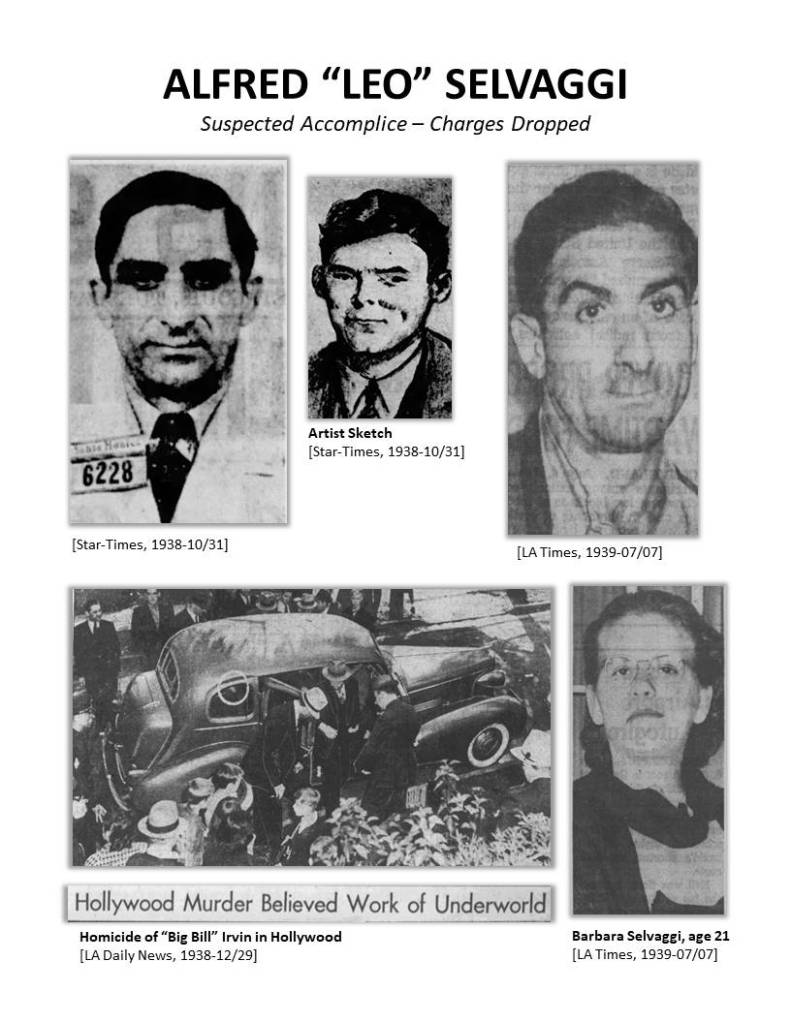
Selvaggi was a native St. Louisan and ex-con who ran in the same circles as Londe. In 1926, he went into the Missouri State Penitentiary for armed robbery (over a whopping $4.40), serving just under three years of an 11-year sentence. Upon his release in September of 1929, he moved out to Los Angeles to make a new start working long-haul assignments on cargo ships. However, by 1938, he was again well-known to local authorities for palling around with gangsters when he wasn’t working. LAPD suspected he was trying to muscle his way into local gambling rackets, and they had been keeping close tabs on him since the December 1938 homicide of bookmaker Weldon “Big Bill” Irvin on Hollywood Blvd.
While docked in Honolulu, family in Missouri alerted him that SLMPD was asking questions. Word on the street was that Baker had tentatively identified him from a photo, but investigators did not yet have the probable cause necessary to secure a warrant. When LAPD went to his home in Santa Monica to pick him up for questioning about the Irvin case, they found Leo and his wife, Barbara, loading luggage into the family car. He said they were heading home to St. Louis to clear his name in the attempted murder of Louis Lee Baker.
While he somewhat resembled the sketch, and had a clear connection with Londe, authorities never could find any evidence linking him to Baker or Dowling. He had been in St. Louis to visit family two months prior to the attack, but authorities were able to confirm he was in San Francisco for six weeks thereafter, and staying at a hotel in San Bernadino (60 miles west of Los Angeles) on the night of Baker’s attack. A handwriting expert validated his script in the log book at the hotel. By today’s standards, investigators would have moved on from him quickly.
But in 1939, they didn’t have the crime fighting tools we have today. Experienced policemen had to rely on gut instinct, and somebody clearly liked Selvaggi for the crime. As soon as he arrived back in St. Louis, the suspect voluntarily went into police headquarters so the witness could view him. But, this time around the mood was different. A year had passed with no signs of Dowling; investigators needed a win. The victim also had 365 days and nights to process his attack, filling in gaps and remembering new details. Upon arrival, Baker immediately made a positive identification, with the blessing of investigators and the County Prosecutor. The in-person ID gave County deputies probable cause to charge assault with intent to kill, and the John Doe indictment was amended to name Selvaggi.
St. Louis County investigated for six weeks, eventually concluding that Selvaggi was nothing more than a plant. He had been marched into Clayton to distract and mislead investigators, and to weaken public sentiment in the State’s case against Londe and his friends. Louis Lee Baker never should have been shown a photo of Selvaggi without any evidence supporting means, motive, or opportunity. But instead of taking it on the chin, the County dropped the charges stating no evidence could be found to support Mr. Baker’s vigorous identification.
Leo and Barbara returned to Los Angeles after the County cut him loose. In order to avoid further questioning in the Irvin homicide, he signed up to be a Merchant Marine; non-military, commercial mariners who transported supplies and personnel to the Pacific during WWII. In the fall of 1944, he is reported missing at sea and Barbara, now going by the name “Beulah,” has him legally declared dead as “Leo John” in order to bury his criminal history. Three months later, the U.S. Navy posthumously decorated L.J. with a civilian medal for his service, removing all objections for the widow to collect death benefits. Investigators never believed the much-younger woman was his wife, but more than likely a partner in crime. The Selvaggis are never seen or heard from again after 1945.
No other suspects were ever prosecuted in Baker’s attempted murder.
Ground Stop
On Sunday, January 14, 1940, Lambert Field was unable to open due to a heavy fog enveloping the city. Inbound airplanes were forced to divert, and outbounds were stopped on the ground. Public officials warned the closure would add significant delays for mail delivery services across the country. But fog wasn’t the only surprise that had rolled into St. Louis the night before.
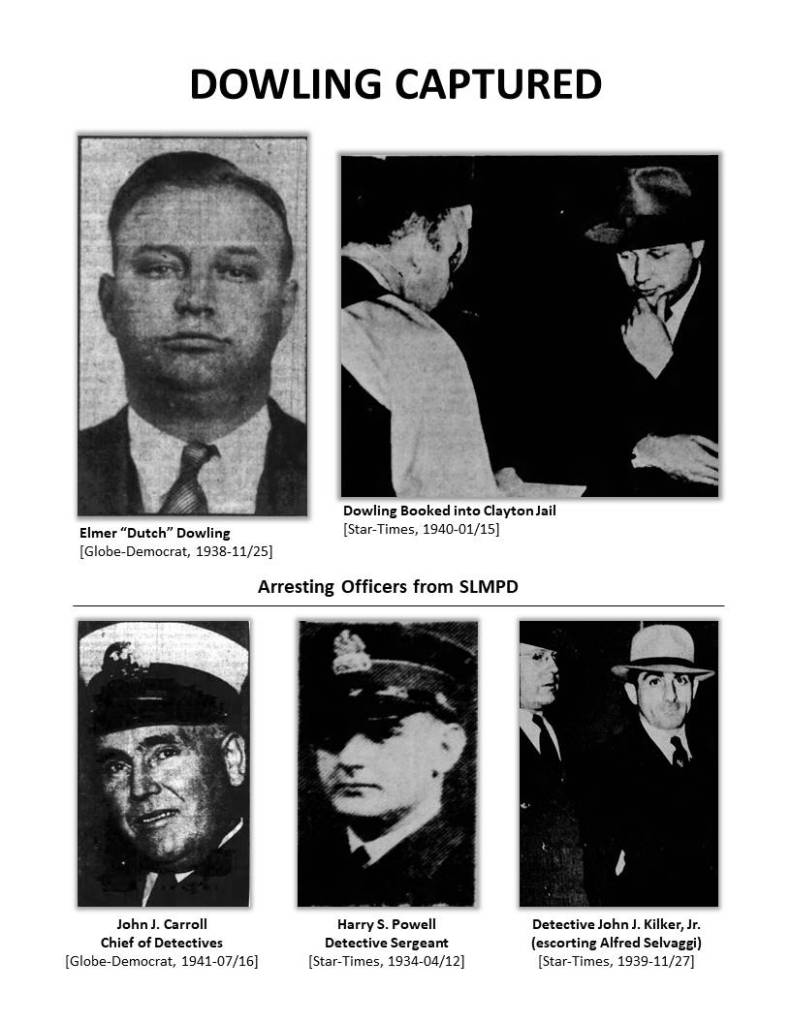
Around 7:00 P.M. on Saturday evening, an anonymous tipster called the home of John Carroll, SLMPD Chief of Detectives. He shared that fugitive Elmer Dowling was planning to make an appearance near the intersection of Taylor Avenue and North Broadway in about three hours. The caller specified that Carroll plus two of his detectives, Powell and Kilker, needed to be there. After hanging up, he wondered if it might be a prank; a ruse to waste the Saturday night of three disliked investigators. Dowling was rumored to be dead, and Taylor and Broadway is the southeast corner of Bellefontaine Cemetery. Was his spirit somehow supposed to emerge from the fog? Worse yet, could this be an ambush? Begrudgingly, he decided to follow the lead and see what happened. He pulled in Powell and Kilker to join him as requested, and also notified the County Sheriff to be on standby.
The three of them piled into an un-marked car to stake out the intersection from a safe distance away. Sure enough, shortly after 10:00 PM, a vehicle pulls up and a man they immediately recognize to be Elmer Dowling crosses the street to enter one of the store fronts. They quickly move in to make the arrest.
Inside, they find Dowling casually chatting with the cashier, purchasing a pack of cigarettes. Hardly looking the part of a fugitive on the lam, he is clean-shaven and neatly dressed in a navy-blue striped suit, crisp white shirt, and red striped tie. The large, strapping business man cooperated with the arresting officers’ requests, but declined to answer any questions until his lawyer arrived.
As he grinned for the press at the Sheriff’s Office in Clayton, photographers remarked how he struggled to squeeze his wide, linebacker frame into the wooden arm chair to which he was handcuffed. They also noted how suntanned and fit he was, as though he’d been out baling hay for the last 14 months. Certainly not the paunchy bookkeeper one might be expecting from the wanted posters. No way did this burly country ox of a man weigh only 200 pounds.
(C) Kyle Christensen, February 25, 2026, All Rights Reserved.
 TalesfromtheLou.com