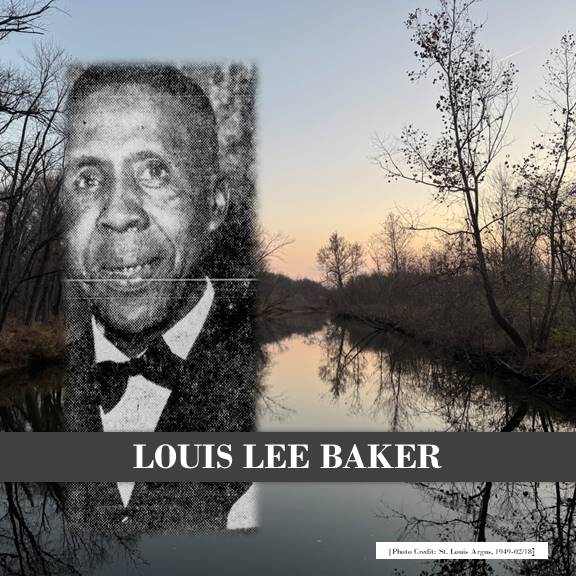
Now alone in his hospital bed, under the protection of two armed guards, Baker began to reflect on the events that led up to his kidnapping and attempted murder. The judge in the Londe trial agreed to give the witness three weeks to compose himself, and all of St. Louis was on edge to hear what he would have to say.
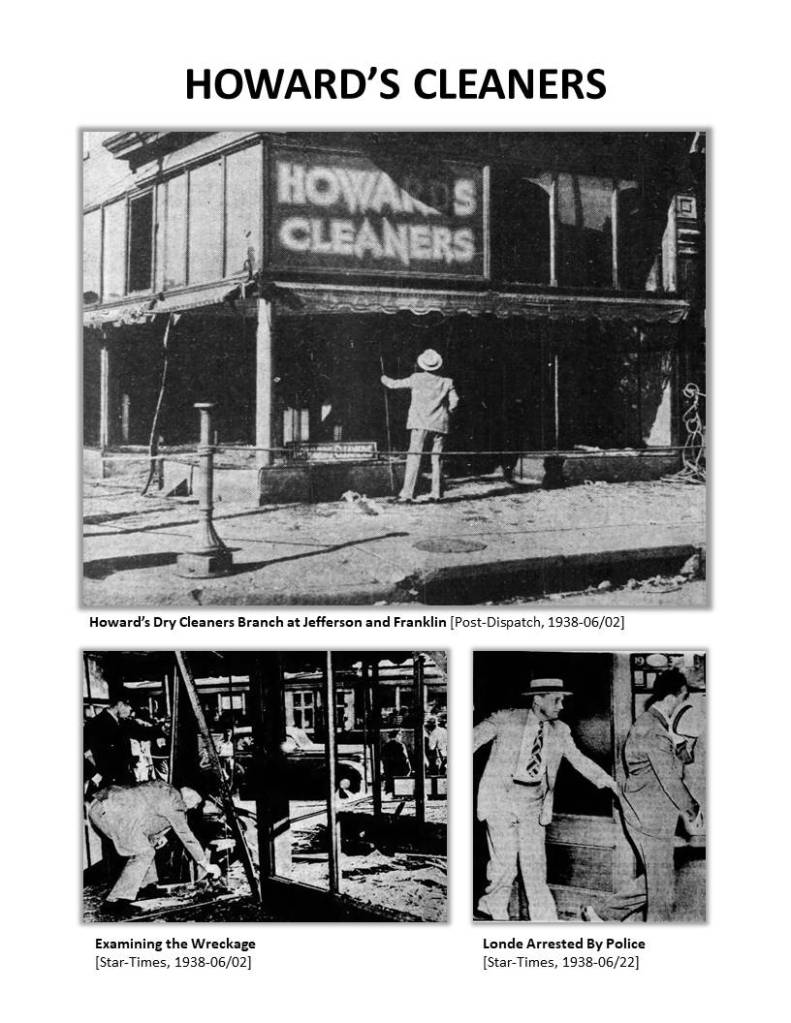
On the morning of June 2, 1938, Lee Baker left his apartment in the Mill Creek neighborhood around 5:30 AM, as he did just about every day. Dampness lingered in the air as he shuffled north along Jefferson Avenue toward the corner bakery for a quick breakfast before hopping on the streetcar line to work. When he reached the intersection of Jefferson and Franklin (now called Martin Luther King), he noticed a dark-colored sedan screech to a stop in front of the Howard’s Dry Cleaners. Intrigued, he watched as the passenger, a white man clad in business attire, casually exited the vehicle and walked back to retrieve something from the trunk. Baker then saw the quick flash of a Zippo lighter, as if the man were lighting a cigarette. He then tossed a small parcel onto the front stoop of the dry cleaners, scrambled back into the passenger seat, and the machine tore off into the night. Moments later, an explosion ripped through the 2600 block of Jefferson, shattering windows and sending Baker to the ground for cover.
Incredibly, he was able to provide responding officers with a very detailed description of the suspect and also recall the license plate started with 6-2-5. SLMPD knew immediately who Baker had seen in the street that morning.
People v. Isadore Londe
Isadore Londe was what the St. Louis Police used to call a “Red-Hot.” Decades before the Sicilians arrived to put the “organized” into crime, the streets of St. Louis were split up between a handful of local gangs, with playful names like Egan’s Rats and the Cuckoo Gang. Red-Hots were the enforcement arm of the various groups; the kind of guys who could turn violent at the drop of a hat. They operated with little regard for their victims or the consequences of their actions. Many of them were just angry young men with nothing to lose, but a select few who excelled in the position (including Londe) were probably what we would describe a “Sociopath” today.
Born in St. Louis in 1904, Londe proudly racked up 53 arrests and two weapons charges by the age of 20. In 1924, he was picked up for armed robbery in Detroit, serving 12 years of a 20-year sentence in a Michigan prison.
According to the Post-Dispatch, eleven prominent St. Louisans wrote glowing letters to the Michigan parole board on behalf of Londe, including two state senators on government stationery. After granting his parole, however, Michigan officials discovered the letters were bogus and drafted on stolen letterhead by Londe’s family and friends. What’s more, his brothers, Louis and Morris, had defrauded creditors of the family business out of $125,000 to help pay for his legal expenses (and a failed, week-long escape attempt that ended in a shootout with deputies). The brothers then committed perjury in federal bankruptcy court, catching each of them a five-year stay at Leavenworth. But despite all of this, Michigan declined to rescind his parole after granting it.
At the time of the bombing, Isadore Londe was just three months off parole, living in his mother’s apartment in University City. Despite having a new wife and a newborn baby, it appears Londe quickly returned to his old ways. He and his vehicle just happened to match Baker’s description perfectly, including the 6-2-5 license plate. Investigators also uncovered that he had checked the machine out of a secured garage shortly after 5 A.M. on the morning of the bombing, and didn’t return it until after 11 o’clock that evening. Police were able to pick up and charge Londe pretty quickly, but a persuasive defense attorney convinced the judge to allow him out on bond until the trial. Following Baker’s attack three months later, the judge revoked his bond, and SLMPD was able to get him back into custody that weekend. Londe claimed to have no knowledge of the Baker incident, explaining that he had just returned from a three-month road trip to California.
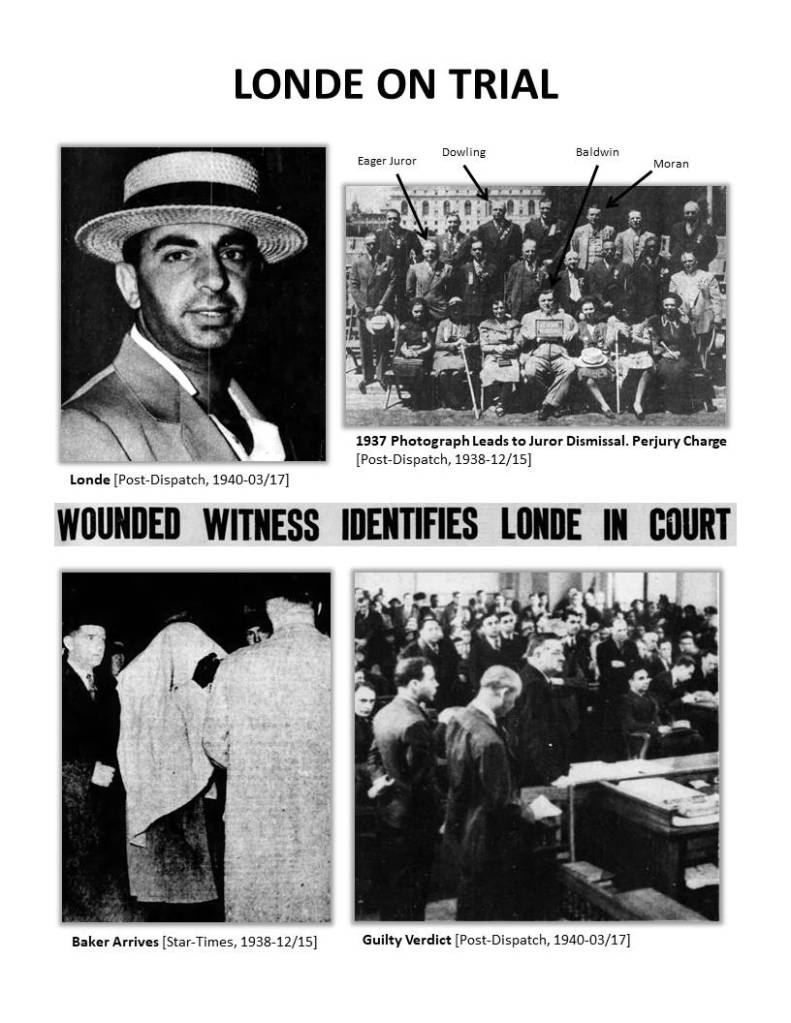
The Londe trial began on Monday, December 12, 1938, and it was front page news all week long. During jury selection, one of Londe’s buddies lied and almost made onto the jury. At the last minute, a photo surfaced which clearly showed the juror with three close associates of Isadore Londe; he was promptly dismissed, arrested, and charged with perjury. Those friends in the photo would re-surface repeatedly throughout the investigation of Baker’s attempted murder.
Londe strolled into court every day that week sharply attired in an oxford gray suit, purple tie and black shoes. However, he appeared to relish being the center of attention more than mounting any kind of defense. For much of the trial, he simply rested his hands lightly on the arms of his chair at the counsel table, staring down each witness who took the stand, unfazed by anyone’s accusations.
But it was the testimony of Louis Lee Baker himself, who arrived on Thursday under a cloak of blankets and police escorts, that people were most interested to hear. For nearly an hour, Baker got on the stand and re-enacted in great detail exactly what he had seen that morning in front of Howard’s Cleaners. At the end, he confidently raised a gnarled finger in the direction of the defendant, giving the jury everything they needed. At 11:52 AM on Friday, December 16th, they returned with a unanimous verdict of guilty. The defendant reportedly again showed no response to the verdict, nor the 25-year sentence imposed by the court.
On the way to the State Penitentiary in Jefferson City, Londe made one additional stop in Cuba, Missouri, about an hour southwest of St. Louis. In a pre-arranged plea deal, he pled guilty to bombing a local business in Cuba about ten days after the Howards’s Dry Cleaners in exchange for a 10-year sentence to be served concurrently.
Probe for the Leak
Outside the walls of the courthouse, public interest in Baker’s kidnapping and attempted murder was intense. Every agency involved was suddenly on the hot seat for failing to protect the witness – Police, Sheriff, and attorneys. On the Monday following the attack, Missouri Governor Lloyd Stark publicly declared war upon organized crime from his office in the Capitol. He instructed, “all state law enforcement machinery to use every power at their command to drive organized crime and criminals, gangsters and racketeers from our state.”
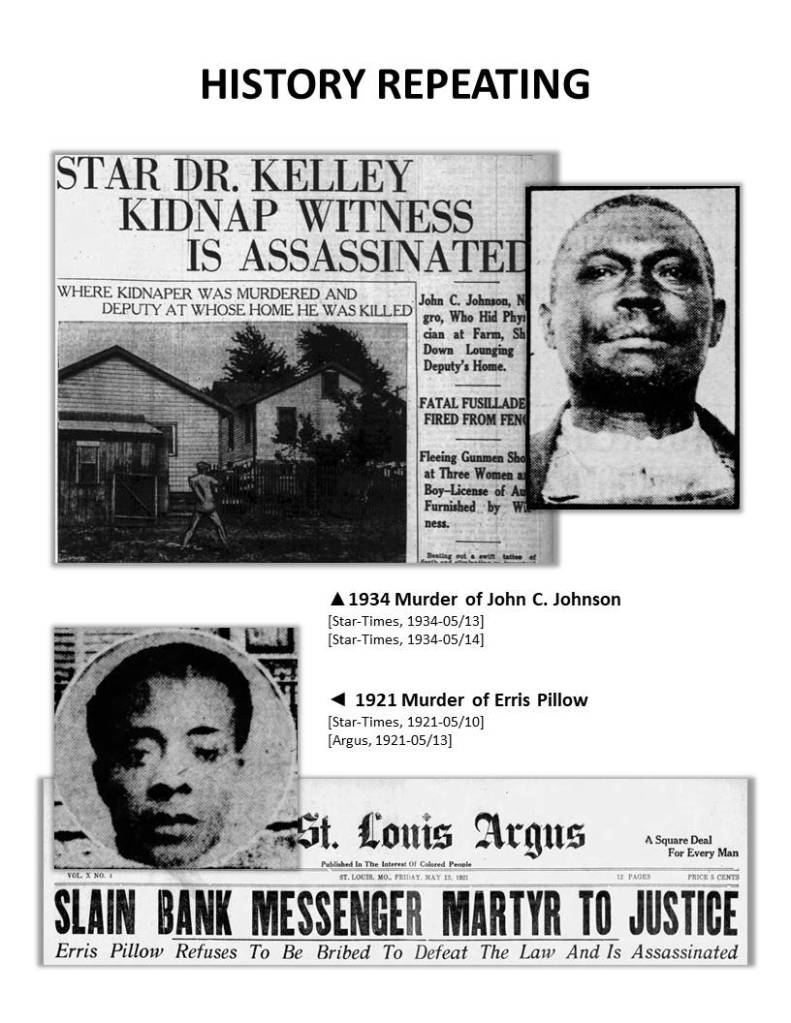
Adding fuel to the fire, competing local newspapers ramped up renewed interest in other recent cases where city and county law enforcement had failed to protect black witnesses. Just four years before the assault on Baker, witness John C. Johnson was set to testify in an extortion case when he was murdered in protective custody at the home of a county deputy. He was executed in broad daylight on the deputy’s front porch in May of 1934. Londe’s pal Babs Moran was indicted for the crime, but the charges were dropped when another witness suddenly disappeared.
In another high-profile case from a little further back in 1921, witness Erris Pillow, a messenger for the St. Louis Savings Trust Company, was assassinated in front of his home on Fairfax Avenue. Gangster Jimmy Hogan went on trial five times in five years for the homicide. In the first trial, he was found guilty and sentenced to fifteen years, but that conviction was overturned on appeal. Prosecutors unsuccessfully tried Hogan three more times for the crime, but the jury never could reach an agreement. His older brother, Edward “Jelly Roll” Hogan, was a powerful state politician into the 1950’s, which all but assured his untouchability. As of 2026, both homicides remain as yet unsolved.
In interviews, Lee Baker recalled the murders of both black witnesses, and acknowledged that he had to push through some (understandable) internal hesitation to bear witness against Londe.
On December 1st, 1938, Police Chief John Glassco stepped forward publicly to accept (some) responsibility for allowing gangsters too much freedom to operate in the city of St. Louis. It wasn’t an apology to Baker or any other witness, but it did acknowledge that law enforcement officers have to maintain the trust of the citizens they are sworn to protect. St. Louis was the eighth-largest city in the country, and it was inevitable that some within the department were cooperating with criminals – or, at least, looking the other way for them at times.
The Chief pledged a full review of everyone on the payroll, regardless of position, and zero tolerance for anyone found to be less than 100% committed to their oath. Additionally, about 35-40 officers with desk jobs were being re-assigned to a patrol, had to wear the uniform, and be visible out in the community. No more plain-clothes officers hanging out in backrooms, leaving citizens to wonder whose side they’re really on. It was an aggressive stance, to say the least.
Glassco was a good man who did the right thing, but the public scolding fostered resentment within the department, even among the vast majority of officers who were noble. It was a very black-and-white position; effective policing requires some gray area and finesse. In the time before D.N.A. and the internet, some of St. Louis’ best informants were madams, bookies, vagrants, drunkards, and drug users. Some worried what it would do to case closure rates, and who would really get caught up in this aggressive gangster dragnet.
St. Louis’ black newspaper, the Argus, urged restraint and humility as the law enforcement community ramped up its patrols, arrests, and raids.
City Hero
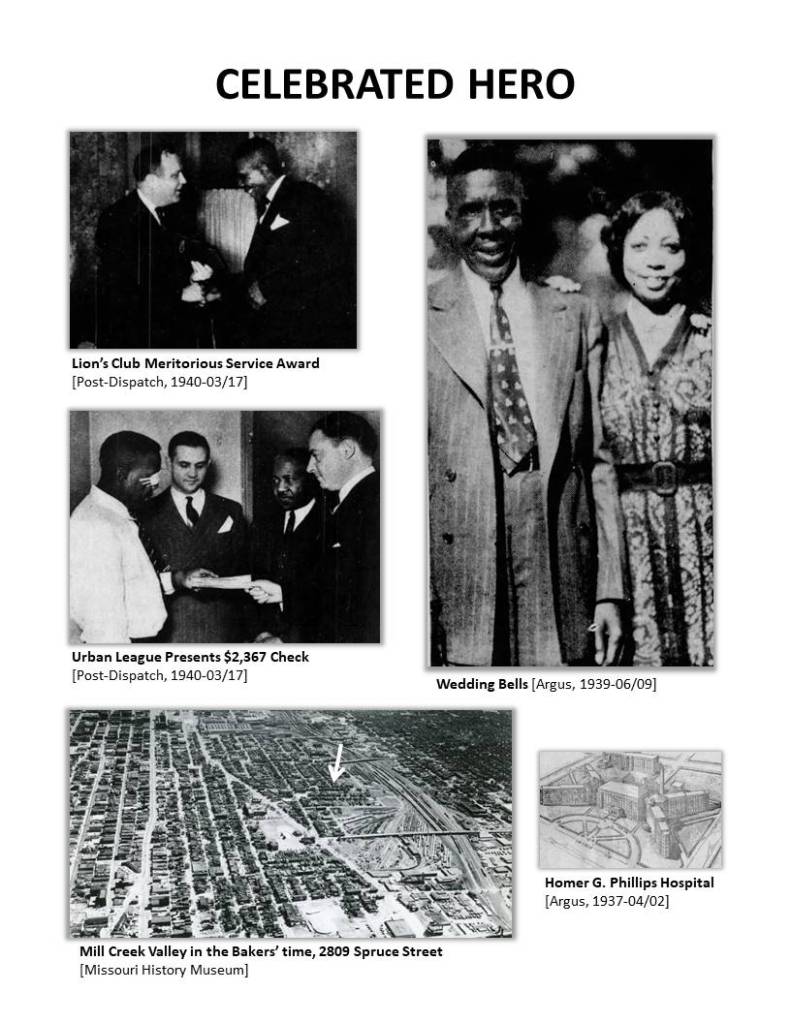
After securing the Londe conviction, Baker was widely celebrated a hero and local celebrity. Business leaders gratefully awarded him the Downtown Lions Club’s Meritorious Service Award. Additionally, Mayor Bernard Dickmann promised Baker a lifetime city job at Homer G. Phillips Hospital for $100/month. And the Urban League collected $2,367 in donations to help him get back on his feet.
In January, he moved over to Homer G. Phillips to begin his new city job and complete three more months of outpatient treatment. Baker was 46 years old, divorced, with a teenage son in his senior year at Vashon High School. Prior to the bombing, he had been thinking about moving back to Vicksburg, MS, to help care for his aging mother, but she passed away while he was in recovery. At this point, he wasn’t really sure what he wanted to do with the next chapter of his life.
Across the street from the hospital, there was a restaurant that Baker began to frequent, with an outgoing and popular young waitress named Odessia Crump. She was ten years younger, widowed, with three teenage boys at home. She and Baker already knew each other from around the neighborhood, and it wasn’t long before feelings began to grow between them at the Grand Terrace Tavern.
In the summer of 1939, the couple decided to get hitched at City Hall and make a new home together at 2809 Spruce Street, a couple blocks southeast of Vashon, now Harris-Stowe State University. One of Baker’s guards, Det. Thomas Brooks was his best man, and Rev. William Fierson from the A.M.E. Church officiated. Using some of the money from the Urban League, they were able to purchase a new car for $800 and take a proper honeymoon. He wasn’t getting rich by any means; the average annual income in 1938 was about $800 more than his $1,200 salary from the city. But with roughly 18% unemployment nationwide, it was still far more than the average earnings for most black men of the day (just $639), and everything a modest, God-fearing man from the Delta needed to be happy.
Unfortunately, cracks in Louis Lee Baker’s public reputation were beginning to appear, even as city leaders praised him. As local media outlets explored different angles for the information leak, the assertion that Baker himself had broken cover was gaining traction. It was first reported that he had told his ex-girlfriend’s mother where he was going in case his family reached out. Then, another story claimed he had revealed his identity to friends at the Trail Back Plantation. Both angles were thoroughly investigated by SLMPD, de-bunked, and walked back in the papers, but the accusation persisted.
Among his new white friends, he was increasingly becoming characterized as a dim-witted, country bumpkin who managed to foil clever mobsters through a comedy of errors. It wasn’t an accurate portrayal at all, but he didn’t have the tools or opportunity to narrate his own story. He tried to take the “un-educated negro” label in stride, but it quickly began to wear on him.
(C) Kyle Christensen, February 25, 2026, All Rights Reserved.
 TalesfromtheLou.com