On a clear and cold night in November of 1938, a human figure trudged silently through the swampy farmlands of the Missouri Bottoms. Few people live in this part of St. Louis County due to frequent flooding; artificial lights and gravel roads would have been few and far between. A waning crescent moon and a sky full of stars overhead were of little interest as his gaze was fixed upon the bright lights of the Howard Bend Water Works rising tall above the banks of the Missouri River.
Just after 2:00 A.M., a wounded black man stumbled into the pump room at Howard Bend, much to the surprise of the only employee on duty that night. Soaked in blood and concealing the right side of his head with a rag, he implored engineer Ed J. Roberts to summon authorities. The man explained he had been in a terrible car accident, wandering the area for hours knocking on doors, unable to raise anyone for assistance.
Stunned and not really sure what to do, Roberts telephoned the County Sheriff, who in turn dispatched two units from the Missouri State Highway Patrol. As the two men settled in to wait for help to arrive, the severity of the victim’s injuries stood out in sharp contrast against the brutalist, industrial decor of the pump room. That must have been one hell-of-a bad accident.
Blood on their Hands
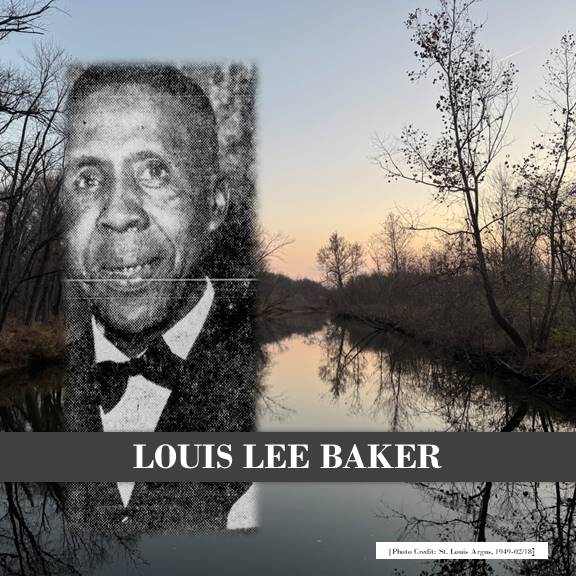
When authorities arrived, the wounded man was identified to be Louis Lee Baker, 45 years of age, from St. Louis City. M.S.H.P. quickly transported him the 18 or so miles to the old County Hospital in Clayton, where the true extent of his injuries became apparent. Doctors discovered two gunshot wounds to the head, one through the cheek just below the right eye, and another one, possibly two, to the right side of his neck. It was a miracle for Baker to be alive, much less alert and responsive. But, aside from losing an eye, doctors predicted he would be OK.
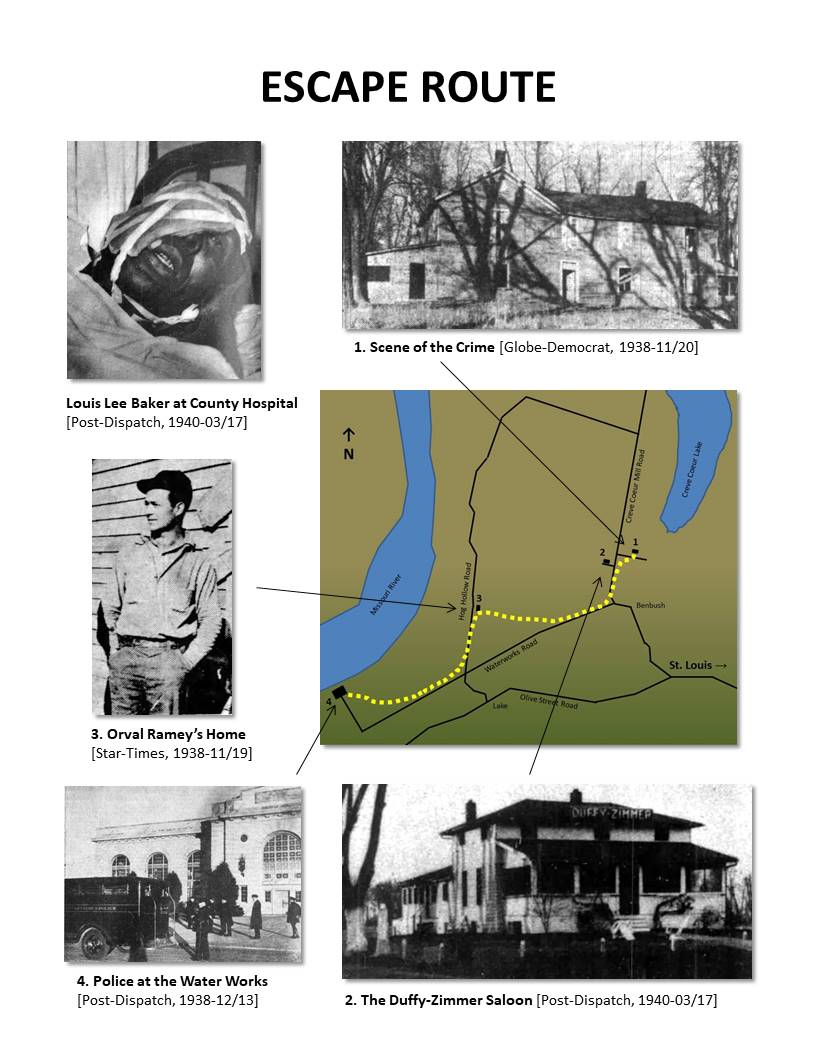
Meanwhile back at the Water Works, Highway Patrol was unable to locate the alleged accident scene, so they tossed the investigation back over to the Sheriff. Shortly after sunrise, a farm worker living on Hog Hollow Road about 1-2 miles north of the plant flagged down a deputy to share additional information. Mr. Orval Ramey reported that Baker had come to his door around 10:00 PM that night, asking only for a rag to bind his wounds and directions to the Water Works. He could see the man was in terrible shape. Ramey offered to call for help and let him inside to warm up, but Baker insisted on walking the remaining distance to the plant. Given the circumstances, a black man approaching a rural stranger’s door in the middle of the night, the brief exchange was odd but somewhat understandable.
Around the same time Ramey was chatting with the deputy, St. Louis City Police Chief John Glassco was learning about the events unfolding in the County. He knew exactly who Louis Lee Baker was, and that his department was supposed to be protecting him with the utmost priority. Baker had been the only witness in the 1938 bombing of a local dry cleaners, and he was about to testify against the vicious St. Louis gangster Isadore Londe on trial for the crime. Londe and his associates took great pleasure in witness tampering and intimidation. Absolutely no one – including the Chief himself – was supposed to know Baker’s location.
Right out of the gate, Glassco suspected his department may have Baker’s blood on their hands that morning. In fact, he slipped up and told the Globe-Democrat later that day, “there must be a leak”; a comment which he repeatedly tried to walk back in later briefings. He was a genuinely good man and a solid policeman, but after 30-plus years on the force, the gangsters were definitely under his skin.
Normally, at this point, it would have been customary to move a stable black patient from County Hospital over to the city’s “colored hospital” for his comfort. Instead, the Chief was sending one of his top lieutenants and a guard unit out to Clayton to regain possession of their most valuable witness.
They Claimed to be Police
By lunchtime on Saturday, Louis Lee Baker was awake and recounting the night’s events with police and reporters from his hospital bed. Covered in bandages and comforted by morphine, visitors tried to ask every question possible, unsure if he might succumb to his injuries at any moment. It was clear, too, that he wanted to get all the details of his experience, on the record, as fast as possible.
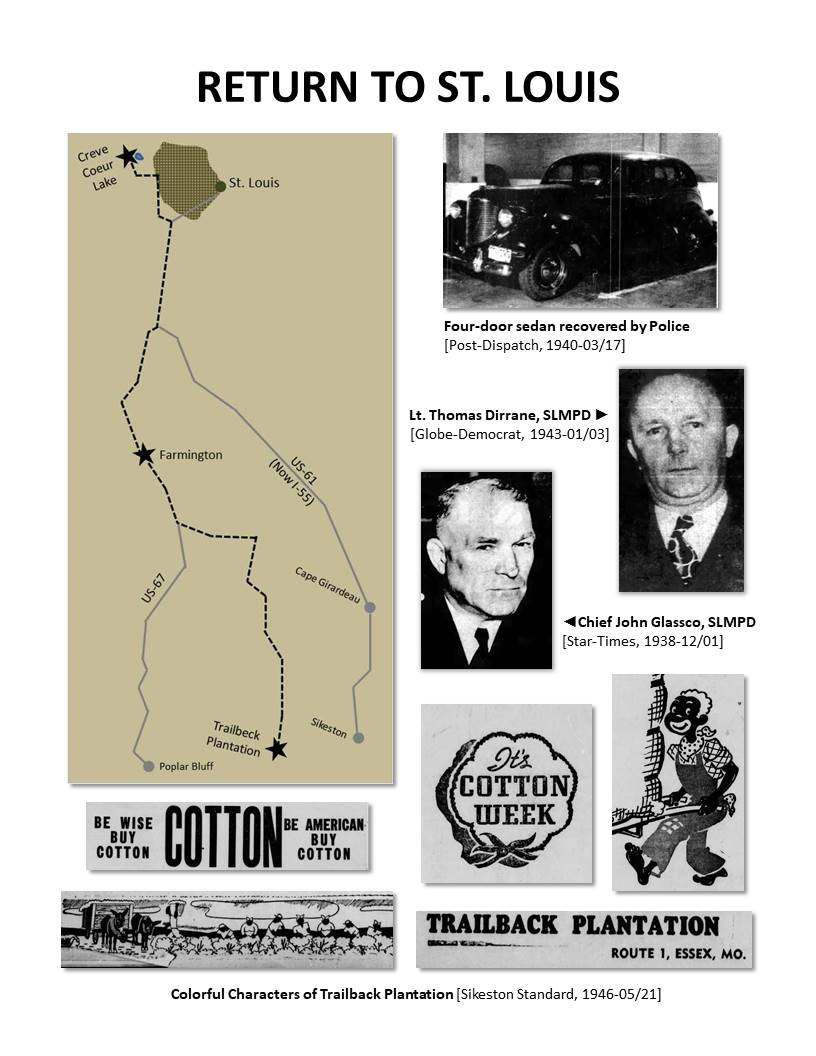
Reporters learned that SLMPD Lieutenant Thomas Dirrane, head of the bomb squad, had been assigned to take the lead on protecting Baker. He was the lead investigator on the Dry Cleaners bombing case and a go-to expert on all things related to organized crime. Dirrane helped arrange for the witness to be placed on a cotton farm near Sikeston, Missouri, about 150 miles south of St. Louis. The Lieutenant also coached Baker that when SLMPD returned to pick him up, they would confirm themselves to be police by offering up a few dollars for cigarettes or refreshments upon approach.The plan was bullet-proof; or, so they thought.
In actuality, the bucolic cotton farm turned out to be the Trailback Plantation, a 4,000 acre work farm in Stoddard County, about 17 miles west of Sikeston. Founded in 1856, it had been part of the Missouri “Dixie Belt” movement in which wealthy Southerners tried to build a powerful cotton industry in Missouri, contingent upon enslaved labor, in an effort to slow abolition. In the decades after the Civil War, Trailback evolved into a sort of catch-all place where rural people of color, paroled criminals, widows, orphans, and the elderly could go when they had no other options. It was exactly the kind of antebellum fever dream that Baker had left behind in Mississippi. And for three uncomfortable summer months, he would be forced to work the fields to earn his room and board.
On the afternoon of Friday, November 18, 1938, two middle-aged white men pulled up to the farm in a black, four-door Pontiac sedan. The driver said he had been sent by the lieutenant to collect Mr. Baker for the trial, offering up a five-dollar bill, just as Dirrane had promised. Clad in suits, heavy overcoats, and woolen hats, the expressionless gentlemen certainly looked the part of hardened detectives. Baker was unaware they were coming, but also not surprised as he was scheduled to testify in court on Monday. Elated that his Gone with the Wind-themed vacation was finally ending, it took little convincing for him to run inside to collect his modest belongings and settle up with the landlady.
According to Baker, the driver was a short, stocky man, weighing over 200 lbs., with a stubble of beard and a heavy voice. He wore a dark grey overcoat over a heavy gray sweater, and a grey flannel hat with a black band. His companion, who he addressed as “Tom,” was taller and more slender, with a heavy crease on the right side of his mouth. Baker described Tom as having a “poor, skinny face, and poor shoulders.” He wore a dark suit with a blue overcoat and a brown hat.
The four-hour drive to St. Louis on US-67/61 was long, but overall pleasant. Shortly before sunset they made two stops in Farmington; one for gas, and one for whiskey. As they pulled into St. Louis, the driver asked his companions to permit him a quick detour out to Creve Coeur Lake. He explained that he was off the next four days and wanted to pick up some hunting supplies from a friend.
For the first time on this trip, Baker began to sense something was off. Traveling deep into the County after sundown made him feel uneasy – even under the escort of two, white police officers. The ways of segregation were understood and observed by both blacks and whites. In the same way children head home just as the streetlights come on, residents of color in St. Louis were conditioned to retreat into the safety of the Wellston Loop streetcar depot before sunset.
A Drunken Friend
The trio pulled into the gravel parking lot of the Duffy-Zimmer Resort on Creve Coeur Mill Road sometime around 7:30 pm. It was a sprawling compound with a saloon, hotel, cabins, horse barns, trap shooting, and a dirt race track. Some thirty years earlier, Upper Creve Coeur Lake had been quite popular among city folks looking for outdoor recreation via streetcar. However, by the mid-1930s, repeated flooding from the Missouri River had nearly silted the Creve Coeur Lakes into extinction. Nowadays, Duffy’s was primarily just a dance hall and saloon for West County rabble-rousers – and a well-documented hangout for St. Louis gangsters.
However, despite its rural location, the large roadhouse did appear to be quite well-attended on that Friday night. With Baker being a person of color, all three agreed it would be best if just the driver run inside to see his friend while the others waited in the car. After about ten minutes, he returned from the saloon, empty-handed but informed. His friend, he said, had gotten drunk and retired himself to an old farmhouse across the road, about 300 yards away. They would still need to chat with him before they could start back toward the city.
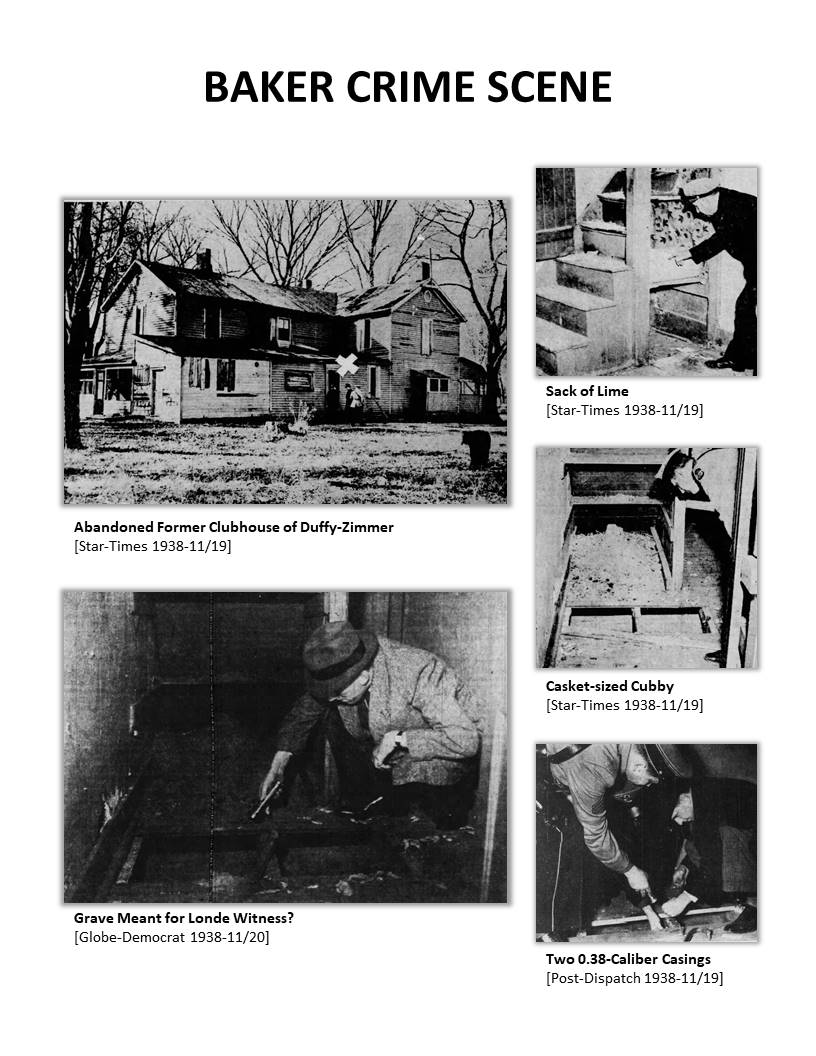
Moments later, the sedan was groaning to a stop in front of what appeared to be an abandoned farmstead. Informed only by the warm glow of incandescent headlights, Baker could slightly make out what appeared to be a rundown shack, set back from the road a bit, contained within a thick stand of trees. There were no indications of recent human occupation whatsoever, nor any other cars, lanterns or the stirrings of a drunk friend. The driver asked his companions to come inside and help him carry the hunting gear out to the car. At this point, Baker is feeling very anxious about leaving the safety of the backseat for whatever might be about to go down. He complied with the driver’s request, but also began mentally preparing himself to bolt into the icy cloak of the surrounding woods at any moment.
The stocky, bullish detective then produced a small flashlight from the car, calling out again for his inebriated friend as all three men started toward the entrance of the dilapidated structure. Flanked by the two policemen, Baker begrudgingly pushed forward into the darkness alongside them. As they crossed the threshold, one went left and one went right, as if to secure the corners of the room. Several steps into the building, however, Baker realized the policemen had silently come back together behind him. Before he could turn around, tall and slender Tom delivered a powerful strike upon the back of the head which laid him out, face-down, upon the cold cement floor. Unsure as to what had just happened, he then heard Tom say to his companion, “You’d better shoot the n—– again.” Without any further discussion, Baker then felt the larger man crouch down at his side, place the cold steel of a pistol upon his neck, and pull the trigger. All he could do was lay there motionless, hopefully slipping out of consciousness before his brain could register any kind of pain from the injuries. In the moment, Baker recalled feeling totally at ease, as though his spiritual awareness had separated from his now-dead body.
But, for reasons known only to God and the would-be assassins, they fired no further shots. The pair lingered there in the stillness of the empty shack for a few more minutes, briefly monitoring for any further signs of life before departing. He presumed they were circling back to Duffy-Zimmer to warm up, and perhaps to rally some additional friends to help with disposal of the body. As soon as Baker heard the car pull away, he began rocking his body from side-to-side and testing his limbs for functionality. As he assessed his surroundings, he also came to realize that he had fallen perfectly into a casket-sized cut-out in the cement floor. Incredibly, he was able to muster the strength to lift himself out of this burial vault and crawl a significant distance to the safety of the woods, within a matter of only a few minutes. In his exit, he stumbled over a sack of cement, which investigators later revealed to be lime; “plaster burials” help mask the odor of decomposition.
At this point, Baker’s memory begins to fade. He reported that from his hiding spot in the woods, he may have overheard someone returning to the abandoned shack that night. All he could piece together was a frantic exit, with a man exclaiming, “Drive like Hell!” as the vehicle peeled out. Who knows if it was real, or the random firings of a mind on the edge of death.
Only the Missouri Bottoms will ever know the full details of exactly how Louis Lee Baker managed to stumble almost four-and-a-half miles to the pump room at Howard Bend that night. The Sheriff’s Office estimated he had wandered, in near-freezing temperatures, for about six hours. Despite the challenges, he still had the wherewithal to navigate an unfamiliar area in total darkness, and to evade detection by anyone at the crowded Duffy-Zimmer saloon, which stood directly between the abandoned shack and Orval Ramey’s home on Hog Hollow Road.
(C) Kyle Christensen, February 25, 2026, All Rights Reserved.
 TalesfromtheLou.com